

Team building activities are one of the easiest ways to improve communication, build trust, and create stronger relationships within a group. Whether you manage a small business, lead a classroom, coach a sports team, or organize community events, the right activity can help people connect, work better together, and enjoy the experience.
Many people think team building is only about playing games, but it goes much further than that. A well-planned activity encourages teamwork, improves problem-solving, develops leadership skills, and creates a positive environment where everyone feels included. Even a simple 10-minute exercise can make meetings more engaging and strengthen collaboration.
This guide at Daily Idea Book brings together 50+ activities for team building for different situations, including indoor, outdoor, and virtual settings. Every activity is organized with practical details such as time required, ideal group size, budget, materials needed, and the main purpose, making it easier to choose the right option for your team.
Whether you’re looking for quick icebreakers, creative challenges, or full-day team events, you’ll find ideas that fit different team sizes, goals, and budgets.
What Are Team Building Activities?
Team building activities are structured games, exercises, or challenges that help people work together more effectively. They encourage participants to communicate, solve problems, support one another, and build stronger relationships while working toward a shared goal.
Unlike everyday work tasks, these activities place people in a relaxed environment where they can interact in new ways. This often reveals hidden strengths, improves understanding between team members, and creates lasting connections.
Team building activities can be used in many settings, including:
- Workplaces
- Schools and colleges
- Sports teams
- Volunteer organizations
- Community groups
- Training programs
- Remote teams
Some activities last only five minutes, while others may take several hours. The best choice depends on your team’s goals, available time, group size, and budget.
Team Building vs. Team Bonding vs. Icebreakers
These three terms are often used interchangeably, but they serve different purposes.
Team Building
Team building activities focus on improving how people work together. They usually involve collaboration, communication, leadership, or problem-solving.
Team Bonding
Team bonding is about strengthening personal relationships. The main goal is helping people know each other outside of regular work or study.
Icebreakers
Icebreakers are short activities that help people feel comfortable before meetings, workshops, or events.
Understanding the difference helps you choose activities that match your objectives instead of selecting games randomly.
Why Team Building Activities Matter
Strong teams don’t happen by chance. They develop through shared experiences, open communication, and mutual trust. Team Booster Activities create opportunities for these qualities to grow naturally.
When people work together in enjoyable and meaningful ways, they become more confident, supportive, and willing to share ideas. This leads to better teamwork during everyday tasks.
Organizations of all sizes use team building because it can help:
- Improve communication
- Increase trust
- Boost employee engagement
- Encourage collaboration
- Develop leadership skills
- Reduce workplace stress
- Welcome new team members
- Improve morale
- Build a positive team culture
Even small activities completed regularly can have a lasting impact on team performance.
Benefits of Team Building Activities
Improve Communication
Good communication is the foundation of every successful team. Team building activities encourage people to share ideas, ask questions, listen carefully, and give constructive feedback.
Many games require participants to explain instructions clearly or solve challenges together, making communication feel natural rather than forced.
Build Trust
Trust grows when people rely on one another to complete a task. Team building exercises create situations where everyone contributes toward a common goal, helping participants feel supported and valued.
As trust increases, teams become more comfortable sharing opinions, asking for help, and working together.
Encourage Collaboration
Successful teams understand that working together often produces better results than working alone. Collaborative activities teach participants how to combine different skills, divide responsibilities, and support one another.
This improves cooperation during real projects and everyday work.
Boost Employee Engagement
People who enjoy working with their teammates are often more motivated and engaged. Fun and meaningful activities create positive experiences that make employees feel connected to the organization.
Higher engagement often leads to better participation, improved productivity, and stronger workplace relationships.
Strengthen Problem-Solving Skills
Many team building games involve puzzles, creative thinking, or decision-making under time limits. These challenges encourage participants to analyze situations, share ideas, and find practical solutions together.
These skills transfer directly to workplace projects and daily responsibilities.
Develop Leadership Skills
Leadership opportunities naturally appear during team activities. Participants often take initiative, organize tasks, motivate others, or guide discussions.
These experiences help future leaders develop confidence in a low-pressure environment.
Increase Creativity
Creative activities encourage people to think differently and explore new ideas. Whether building a structure, solving a puzzle, or brainstorming solutions, participants practice flexible thinking that can improve innovation at work.
Reduce Stress
A relaxed and enjoyable activity can break the routine of a busy day. Laughing together, completing fun challenges, and celebrating success help reduce stress while improving overall team morale.
Lower stress often leads to better communication and stronger relationships.
Welcome New Team Members
Starting a new job or joining a new group can feel overwhelming. Team building activities help new members become familiar with their teammates more quickly.
This creates a welcoming environment where everyone feels included from the beginning.
Build a Positive Team Culture
Positive team culture develops through shared experiences. Regular team building encourages respect, cooperation, and appreciation among participants.
Over time, these experiences create a workplace where people enjoy collaborating and supporting one another.
How to Choose the Right Team Building Activity
Choosing the right activity is just as important as the activity itself. The best option depends on your team’s goals, available time, group size, location, and budget.
Instead of choosing the most popular game, focus on what your team needs most.
Choose Based on Your Goal
Every activity should have a clear purpose. Understanding your objective helps you select an activity that delivers meaningful results.
Consider Group Size
The number of participants affects how well an activity works.
- 2–5 people: Communication games, puzzles, brainstorming.
- 6–10 people: Icebreakers, creative challenges, trivia.
- 11–20 people: Relay activities, scavenger hunts, problem-solving games.
- 20–50 people: Team competitions, outdoor challenges.
- 50+ people: Large group games with multiple teams.
Dividing larger groups into smaller teams often increases participation.
Think About the Location
The environment plays a major role in selecting activities.
Indoor activities are ideal for offices, classrooms, and meeting rooms.
Outdoor activities provide more space for movement and physical challenges.
Virtual activities work well for remote teams using video conferencing platforms.
Always consider weather conditions, available space, and accessibility before making your choice.
Match the Budget
Great team building doesn’t have to be expensive.
Many excellent activities require little or no money, while others involve professional facilitators or special venues.
A simple conversation game can often be just as valuable as a costly event when it matches your team’s needs.
General budget categories include:
- Free
- Under $25
- $25–$100
- $100–$500
- Premium events
Consider the Time Available
Not every team has hours to spare. Choose activities that fit naturally into your schedule.
- 5–10 minutes: Icebreakers
- 15–30 minutes: Quick team challenges
- 30–60 minutes: Problem-solving activities
- 1–2 hours: Workshops and collaborative games
- Half-day: Multiple activities with discussions
- Full-day: Team retreats and outdoor events
Short activities can be surprisingly effective when used consistently.
Indoor Team Building Activities
Indoor team building activities are perfect for offices, classrooms, conference rooms, and training sessions. They don’t require much space or planning, making them ideal for teams that want to improve communication, collaboration, and trust without leaving the building.
Whether you have 15 minutes before a meeting or an hour for a team workshop, these activities can help create a more connected and productive team.

1. Two Truths and a Lie
If your team is meeting for the first time, this simple game is one of the fastest ways to help everyone feel comfortable.
Two Truths and a Lie is a classic icebreaker that encourages conversation while helping team members learn interesting facts about each other. It’s easy to organize, requires no materials, and works well for almost any group.
Quick Information
- Time Required: 10–15 minutes
- Ideal Team Size: 4–20 people
- Budget: Free
- Materials Needed: None
- Best For: Icebreaking, communication, and getting to know teammates
How to Play
- Ask each participant to think of three statements about themselves.
- Two statements should be true, and one should be false.
- Each person reads their three statements aloud.
- The rest of the group discusses and guesses which statement is the lie.
- After everyone votes, the participant reveals the correct answer.
- Continue until every team member has taken a turn.
Why It Works
People naturally become more comfortable when they share personal stories in a relaxed environment. This activity encourages conversation, builds trust, and helps team members discover shared interests that can strengthen workplace relationships.
Pro Tip
Encourage participants to choose surprising facts instead of obvious ones. This makes the game more engaging and sparks better conversations.
2. Marshmallow Challenge
Want to improve teamwork and creative thinking? The Marshmallow Challenge is a fun way to see how teams solve problems under pressure.
In this activity, teams work together to build the tallest free-standing tower using limited materials. Although it looks simple, the challenge quickly becomes a lesson in communication, planning, creativity, and teamwork.
Quick Information
- Time Required: 25–30 minutes
- Ideal Team Size: 4–6 people per team
- Budget: Low
- Materials Needed: Spaghetti sticks, masking tape, string, one marshmallow per team
- Best For: Collaboration, creativity, leadership, and problem-solving
How to Play
- Divide participants into small teams.
- Give each team the same materials.
- Explain that they must build the tallest free-standing structure.
- The marshmallow must be placed on top of the structure.
- Set a timer for 18–20 minutes.
- When time is over, measure each tower.
- The tallest standing tower wins.
Why It Works
This activity encourages participants to test ideas, adapt quickly, and communicate effectively. Teams often discover that planning alone isn’t enough—they must also experiment and adjust as they work together.
Pro Tip
Avoid giving teams advice during the challenge. Let them learn through trial and error, then discuss what worked well afterward.
3. Office Trivia
Friendly competition can make learning about your workplace much more enjoyable.
Office Trivia is a fun quiz game where participants answer questions about the company, coworkers, workplace history, or general knowledge. It’s a simple activity that improves engagement while helping employees feel more connected to their organization.
Quick Information
- Time Required: 20–30 minutes
- Ideal Team Size: 5–30 people
- Budget: Free
- Materials Needed: Trivia questions, whiteboard or presentation slides (optional)
- Best For: Communication, engagement, and team bonding
How to Play
- Prepare 20–30 trivia questions before the activity.
- Divide participants into small teams.
- Read one question at a time.
- Allow teams one minute to discuss their answers.
- Award one point for every correct answer.
- Continue until all questions have been answered.
- The team with the highest score wins.
Why It Works
Working together to answer questions encourages discussion and active participation. It also gives employees the chance to learn more about their colleagues and workplace in a relaxed setting.
Pro Tip
Mix work-related questions with fun topics to keep the game interesting for everyone.
4. Human Knot
Sometimes the best teamwork lesson comes from solving a challenge without using technology or expensive equipment.
Human Knot is a popular team building activity that requires participants to untangle themselves while staying connected. Success depends on communication, patience, cooperation, and problem-solving rather than physical strength.
Quick Information
- Time Required: 15–20 minutes
- Ideal Team Size: 6–12 people
- Budget: Free
- Materials Needed: None
- Best For: Communication, trust, collaboration, and problem-solving
How to Play
- Ask everyone to stand in a circle.
- Each participant reaches across the circle and holds one person’s hand.
- They then grab a different person’s hand with their other hand.
- The group must untangle itself without letting go of anyone’s hands.
- Participants should communicate and move carefully while solving the puzzle.
- The activity ends when everyone forms one large circle or another agreed shape.
Why It Works
The Human Knot teaches teams to stay calm, listen carefully, and solve problems together. Participants quickly learn that clear communication and cooperation are more effective than rushing toward a solution.
Pro Tip
If your group is large, divide participants into smaller circles. Smaller teams make the activity easier to manage and ensure everyone stays actively involved.
5. Blind Drawing
Clear communication is the key to success, and Blind Drawing is one of the best activities to practice it in a fun way.
Blind Drawing is a simple team building exercise where one person describes an image while another person draws it without seeing the original picture. This activity highlights the importance of giving clear instructions and listening carefully.
Quick Information
- Time Required: 15–20 minutes
- Ideal Team Size: 4–20 people
- Budget: Free
- Materials Needed: Paper, pens or pencils, printed images
- Best For: Communication, listening skills, teamwork, and creative thinking
How to Play
- Divide participants into pairs.
- Give one person in each pair a picture without letting their partner see it.
- The person with the picture describes it using only words.
- The other person tries to draw the picture based on the instructions.
- Once the time is up, compare the drawing with the original image.
- Switch roles and repeat with a different picture.
Why It Works
Blind Drawing teaches participants how important clear communication is. It also helps improve listening skills, patience, and attention to detail while creating plenty of laughter.
Pro Tip
Choose simple pictures for beginners and more detailed images for experienced teams to keep the challenge enjoyable.
6. Paper Tower Challenge
Great teamwork often starts with simple materials and a creative idea.
The Paper Tower Challenge asks teams to build the tallest free-standing tower using only paper and tape. Although the materials are basic, the activity encourages planning, experimentation, and collaboration.
Quick Information
- Time Required: 20–30 minutes
- Ideal Team Size: 3–6 people per team
- Budget: Low
- Materials Needed: Sheets of paper, masking tape, scissors (optional)
- Best For: Problem-solving, creativity, leadership, and teamwork
How to Play
- Divide participants into small teams.
- Give each team the same number of paper sheets and tape.
- Explain that they must build the tallest tower possible.
- The tower must stand on its own for at least 30 seconds.
- Set a timer for 20 minutes.
- Measure each tower after the time ends.
- The tallest stable tower wins.
Why It Works
This activity encourages teams to test ideas, learn from mistakes, and improve their designs together. It also demonstrates the importance of planning while remaining flexible when challenges arise.
Pro Tip
After the challenge, ask each team to explain their strategy. Sharing different approaches helps everyone learn from one another.
7. Puzzle Race
Working together under a time limit is an excellent way to improve collaboration and decision-making.
Puzzle Race is a friendly competition where teams complete identical jigsaw puzzles as quickly as possible. Success depends on communication, organization, and everyone’s willingness to contribute.
Quick Information
- Time Required: 20–40 minutes
- Ideal Team Size: 3–6 people per team
- Budget: Low to Medium
- Materials Needed: Identical jigsaw puzzles for each team
- Best For: Collaboration, planning, communication, and problem-solving
How to Play
- Divide participants into equal teams.
- Give each team the same puzzle.
- Explain the rules before starting.
- Start the timer.
- Teams work together to complete the puzzle.
- The first team to finish correctly wins.
- Review how each team organized their work.
Why It Works
Puzzle Race encourages participants to divide tasks, communicate effectively, and support one another instead of working individually. It also reinforces the value of teamwork when solving complex problems.
Pro Tip
Choose puzzle difficulty based on your group’s experience and available time to keep everyone engaged.
8. Indoor Scavenger Hunt
If you want to get everyone moving while encouraging teamwork, an Indoor Scavenger Hunt is an excellent choice.
An Indoor Scavenger Hunt challenges teams to find hidden objects or complete simple tasks within a set time. It combines communication, observation, and problem-solving into one enjoyable activity.
Quick Information
- Time Required: 30–45 minutes
- Ideal Team Size: 6–30 people
- Budget: Free or Low
- Materials Needed: List of items or clues, small prizes (optional)
- Best For: Collaboration, communication, engagement, and team bonding
How to Play
- Prepare a list of objects, clues, or challenges before the activity.
- Divide participants into small teams.
- Give each team the same list.
- Set a clear time limit.
- Teams search the office or meeting space while completing the assigned tasks.
- Award points for each completed item or challenge.
- The team with the highest score wins.
Why It Works
This activity encourages participants to communicate, plan their approach, and divide responsibilities. It also creates an energetic atmosphere that helps people connect outside their normal work routines.
Pro Tip
Include a mix of easy and challenging clues so every team stays motivated throughout the activity.
9. LEGO Build Challenge
Creative teamwork becomes much easier when everyone works toward the same goal, and the LEGO Build Challenge is a great example of that.
The LEGO Build Challenge encourages teams to plan, communicate, and solve problems while building a model together. It is suitable for workplaces, classrooms, and training sessions because it promotes creativity without requiring special skills.
Quick Information
- Time Required: 30–45 minutes
- Ideal Team Size: 3–6 people per team
- Budget: Medium
- Materials Needed: LEGO bricks or similar building blocks
- Best For: Creativity, collaboration, leadership, and problem-solving
How to Play
- Divide participants into small teams.
- Give each team an equal number of LEGO bricks.
- Assign a building challenge, such as creating the tallest tower, a bridge, or a model of the company’s future office.
- Set a time limit of 30–45 minutes.
- Teams plan, build, and test their creations.
- Ask each team to present their model and explain their design.
- Choose winners based on creativity, teamwork, or functionality.
Why It Works
Building together requires participants to exchange ideas, divide responsibilities, and make decisions as a group. The activity also encourages creative thinking while allowing every team member to contribute.
Pro Tip
Instead of focusing only on the winning design, ask each team to explain what they learned during the challenge. The discussion often provides more value than the competition itself.
10. Minute to Win It
Short challenges can create big teamwork lessons when every second counts.
Minute to Win It is a collection of quick and entertaining games where teams complete simple tasks within one minute. These fast-paced challenges create excitement while encouraging communication and friendly competition.
Quick Information
- Time Required: 20–40 minutes
- Ideal Team Size: 6–30 people
- Budget: Low
- Materials Needed: Everyday office or household items such as cups, balloons, pencils, coins, or paper clips
- Best For: Team bonding, morale, communication, and engagement
How to Play
- Prepare several one-minute challenges before the event.
- Divide participants into teams.
- Explain each challenge clearly.
- Give each team one minute to complete the task.
- Award points for every successful challenge.
- Continue until all games are completed.
- The team with the most points wins.
Why It Works
The short time limit encourages participants to think quickly, cooperate under pressure, and support one another. Since the games are simple and fun, everyone has an opportunity to participate regardless of their experience.
Pro Tip
Choose a variety of challenges so participants with different strengths have a chance to contribute.
11. Charades
Sometimes the best communication happens without speaking a single word.
Charades is a classic guessing game where players act out words or phrases while their teammates try to guess the correct answer. It is easy to organize and works well for teams of all ages.
Quick Information
- Time Required: 20–30 minutes
- Ideal Team Size: 6–20 people
- Budget: Free
- Materials Needed: Prepared word or phrase cards
- Best For: Communication, creativity, teamwork, and employee engagement
How to Play
- Write words or phrases on separate cards.
- Divide participants into two or more teams.
- One player chooses a card and silently acts out the word.
- Their teammates try to guess within the time limit.
- Award one point for every correct answer.
- Continue until each participant has played at least once.
- The team with the highest score wins.
Why It Works
Charades encourages observation, creative thinking, and teamwork. It also creates a relaxed atmosphere where participants feel comfortable laughing together and supporting one another.
Pro Tip
Customize the word cards to match your workplace, industry, or training topic for a more meaningful experience.
12. Story Circle
Every team has unique ideas, and Story Circle helps bring those ideas together in a creative way.
Story Circle is a collaborative storytelling activity where each participant adds one sentence to build a shared story. The exercise encourages active listening, creativity, and cooperation while giving everyone an equal chance to contribute.
Quick Information
- Time Required: 15–20 minutes
- Ideal Team Size: 5–20 people
- Budget: Free
- Materials Needed: None
- Best For: Creativity, communication, listening, and collaboration
How to Play
- Ask participants to sit in a circle.
- One person starts with a single opening sentence.
- Moving around the circle, each participant adds one sentence to continue the story.
- Encourage everyone to listen carefully before adding their ideas.
- Continue until the story reaches a natural ending.
- Read the completed story aloud and discuss the experience.
Why It Works
Story Circle demonstrates how every person’s contribution affects the final result. It encourages participants to listen, think creatively, and build on the ideas of others instead of working independently.
Pro Tip
Give the story a fun theme, such as “A Day at the Office,” “The Company’s Biggest Success,” or “A Mission to Mars,” to inspire creative thinking.
13. Minefield
Trust and communication become even more important when one teammate has to rely completely on another.
Minefield is a communication-focused activity where one participant is blindfolded while another guides them through a course filled with obstacles. The challenge teaches teams how to give clear instructions, listen carefully, and work together under pressure.
Quick Information
- Time Required: 20–30 minutes
- Ideal Team Size: 6–20 people
- Budget: Free
- Materials Needed: Blindfolds and small objects (cones, bottles, paper cups, or chairs)
- Best For: Communication, trust, active listening, and teamwork
How to Play
- Place objects around the room to create a simple obstacle course.
- Divide participants into pairs.
- Blindfold one person from each pair.
- The other teammate stands outside the course and gives verbal directions.
- The blindfolded participant must reach the finish line without touching any obstacles.
- Switch roles and repeat the activity.
- Discuss what communication techniques worked best.
Why It Works
Minefield teaches participants that clear communication is just as important as good listening. It also builds trust because one teammate depends entirely on the guidance of another.
Pro Tip
Increase the difficulty by allowing only specific words or limiting the number of instructions each guide can give.
14. Egg Drop Challenge
Creative ideas often come from solving problems together, and the Egg Drop Challenge encourages exactly that.
In this activity, teams design a protective container that keeps an egg from breaking when dropped from a certain height. It combines creativity, planning, and teamwork while creating an exciting competition.
Quick Information
- Time Required: 45–60 minutes
- Ideal Team Size: 3–6 people per team
- Budget: Medium
- Materials Needed: Eggs, paper, cardboard, tape, straws, cotton balls, rubber bands, and other craft supplies
- Best For: Creativity, innovation, collaboration, and problem-solving
How to Play
- Divide participants into small teams.
- Give each team the same materials and one egg.
- Explain that they must design a structure to protect the egg during a drop.
- Set a building time of 30–40 minutes.
- Drop each team’s egg from the same height.
- Check which eggs remain unbroken.
- Ask teams to explain the thinking behind their designs.
Why It Works
The Egg Drop Challenge encourages brainstorming, testing ideas, and adapting plans when things don’t work as expected. It also demonstrates how different skills within a team contribute to solving complex problems.
Pro Tip
Focus on the learning process rather than only the winning design. Ask teams what they would improve if they had another chance.
15. Office Debate
Healthy discussions can strengthen teamwork when everyone listens with respect and keeps an open mind.
Office Debate is a structured discussion where small teams present different viewpoints on a fun or work-related topic. The goal isn’t to prove someone wrong but to encourage critical thinking, respectful communication, and teamwork.
Quick Information
- Time Required: 30–45 minutes
- Ideal Team Size: 6–20 people
- Budget: Free
- Materials Needed: Debate topics and a timer
- Best For: Communication, confidence, leadership, and critical thinking
How to Play
- Prepare several debate topics before the session.
- Divide participants into two teams.
- Assign each team a position to support.
- Give teams time to prepare their arguments.
- Allow each side to present its points.
- Encourage respectful discussion and rebuttals.
- End with a group reflection instead of simply announcing a winner.
Why It Works
Office Debate helps participants organize ideas, communicate clearly, and understand different perspectives. It also improves confidence while encouraging respectful teamwork.
Pro Tip
Choose light-hearted topics if your team is new to debates. Save workplace or business-related discussions for experienced groups.
16. Desert Island Survival Challenge
Making decisions as a team becomes easier when everyone has the chance to share their ideas.
The Desert Island Survival Challenge is a problem-solving exercise where participants imagine they are stranded on an island and must decide which items will help them survive. The activity encourages discussion, negotiation, and teamwork.
Quick Information
- Time Required: 30–45 minutes
- Ideal Team Size: 4–10 people
- Budget: Free
- Materials Needed: Printed list of survival items
- Best For: Decision-making, collaboration, leadership, and critical thinking
How to Play
- Create a list of 15–20 survival items.
- Give every participant a copy of the list.
- Ask individuals to rank the items on their own.
- Form small teams and ask them to create one final group ranking.
- Encourage participants to explain and defend their choices.
- Compare the team rankings with expert survival recommendations if available.
- Finish with a discussion about teamwork and decision-making.
Why It Works
This activity encourages participants to explain their reasoning, listen to different opinions, and reach a shared decision. It demonstrates how collaboration often produces better results than working alone.
Pro Tip
Avoid revealing the expert answers immediately. Let teams explain their choices first so everyone learns from the discussion.
Choosing the Best Indoor Team Building Activity
Not every indoor activity has the same purpose. Choosing the right one depends on your team’s goals, available time, and group size. A short icebreaker may be perfect before a meeting, while a longer problem-solving challenge works well during workshops or training sessions.
Here are some quick recommendations:
- Best for Communication: Blind Drawing, Minefield, Charades
- Best for Collaboration: Marshmallow Challenge, Puzzle Race, LEGO Build Challenge
- Best for Creativity: Story Circle, Egg Drop Challenge, LEGO Build Challenge
- Best for Problem-Solving: Escape Room, Desert Island Survival Challenge, Human Knot
- Best Free Activities: Two Truths and a Lie, Human Knot, Charades, Story Circle, Minefield
- Best for Large Teams: Office Trivia, Indoor Scavenger Hunt, Minute to Win It
- Best for Small Teams: Puzzle Race, Paper Tower Challenge, Marshmallow Challenge
Selecting an activity that matches your team’s objectives will create a more meaningful experience and encourage everyone to participate.
Indoor Team Building Activities Cheat Sheet
| Activity | Time | Group Size | Budget | Best For |
|---|---|---|---|---|
| Two Truths and a Lie | 10–15 min | 4–20 | Free | Icebreaking & Communication |
| Marshmallow Challenge | 25–30 min | 4–6/team | Low | Creativity & Collaboration |
| Office Trivia | 20–30 min | 5–30 | Free | Engagement |
| Human Knot | 15–20 min | 6–12 | Free | Trust & Teamwork |
| Blind Drawing | 15–20 min | 4–20 | Free | Communication |
| Paper Tower Challenge | 20–30 min | 3–6/team | Low | Problem Solving |
| Puzzle Race | 20–40 min | 3–6/team | Low–Medium | Collaboration |
| Indoor Scavenger Hunt | 30–45 min | 6–30 | Free–Low | Team Bonding |
| LEGO Build Challenge | 30–45 min | 3–6/team | Medium | Creativity |
| Minute to Win It | 20–40 min | 6–30 | Low | Morale & Fun |
| Charades | 20–30 min | 6–20 | Free | Communication |
| Story Circle | 15–20 min | 5–20 | Free | Creativity |
| Minefield | 20–30 min | 6–20 | Free | Trust |
| Egg Drop Challenge | 45–60 min | 3–6/team | Medium | Innovation |
| Desert Island Survival Challenge | 30–45 min | 4–10 | Free | Decision Making |
Outdoor Team Building Activities
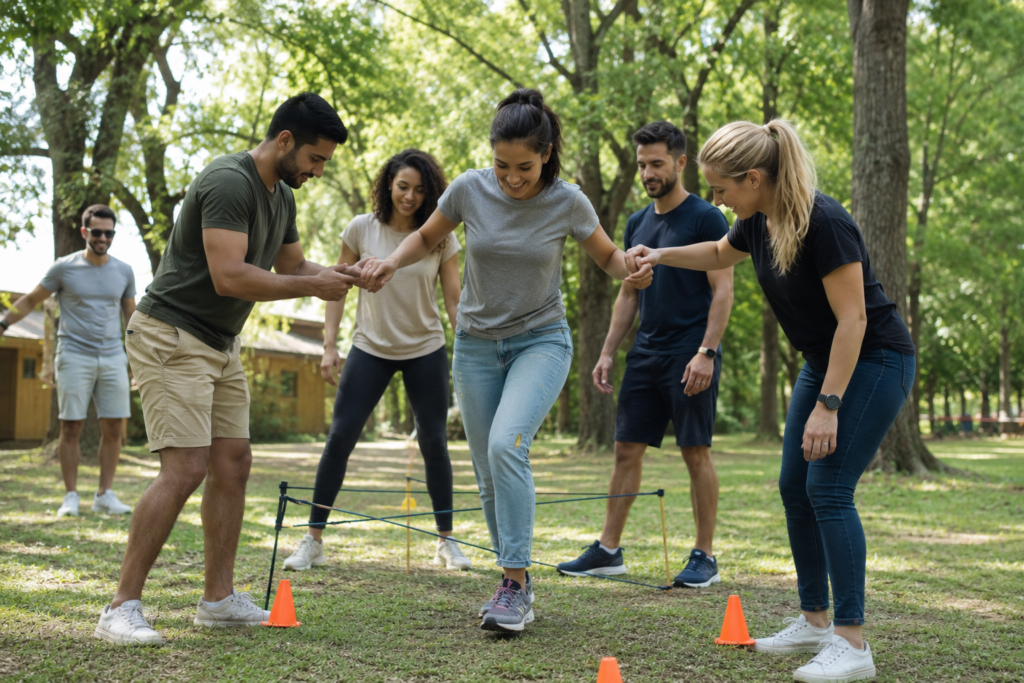
Outdoor team building activities offer a refreshing change from the usual work or classroom environment. They encourage participants to communicate, solve problems, and support one another while enjoying open spaces. Whether you’re planning a company retreat, school event, sports day, or community gathering, outdoor activities can improve teamwork and create memorable experiences.
Many outdoor games also promote physical movement, creative thinking, and leadership. From quick challenges to half-day adventures, there’s an activity for every team size and budget.
1. Treasure Hunt
Treasure Hunt turns teamwork into an exciting adventure where every clue brings the team one step closer to success.
Participants work together to solve clues, find hidden objects, and complete challenges before the other teams. This activity encourages communication, planning, and problem-solving while keeping everyone actively involved.
Quick Information
- Time Required: 45–90 minutes
- Ideal Team Size: 6–50+ people
- Budget: Low to Medium
- Materials Needed: Clue cards, small prizes, maps (optional)
- Best For: Communication, collaboration, and problem-solving
How to Play
- Prepare a series of clues leading to different locations.
- Divide participants into small teams.
- Give each team the first clue.
- Teams solve each clue to find the next location.
- Continue until the final treasure is discovered.
- The first team to complete all clues wins.
Why It Works
Treasure Hunt encourages teams to think together, share ideas, and make decisions quickly. Every participant can contribute by solving clues, navigating locations, or organizing the group’s strategy.
Pro Tip
Mix easy and challenging clues to keep every team motivated throughout the game.
2. Relay Race
Winning a relay race depends on teamwork just as much as speed.
Relay races require participants to complete different tasks while passing responsibility to the next teammate. Success comes from coordination, communication, and supporting one another.
Quick Information
- Time Required: 20–40 minutes
- Ideal Team Size: 8–40 people
- Budget: Free
- Materials Needed: Cones, batons, or simple markers
- Best For: Teamwork, energy, and communication
How to Play
- Divide participants into equal teams.
- Create a simple race course.
- Explain the relay rules.
- Each participant completes one section before passing the baton.
- Continue until every teammate finishes.
- The first complete team wins.
Why It Works
Relay races teach participants that every role matters. Even the fastest runner depends on teammates to complete their sections successfully.
Pro Tip
Add fun challenges between relay stages, such as balancing a ball or solving a quick puzzle.
3. Tug of War
Few activities demonstrate teamwork more clearly than Tug of War.
Instead of relying on individual strength, teams must coordinate their movements and work together to pull against the opposing team.
Quick Information
- Time Required: 15–20 minutes
- Ideal Team Size: 8–20 people
- Budget: Low
- Materials Needed: Strong rope
- Best For: Trust, teamwork, and motivation
How to Play
- Mark the center line.
- Divide participants into two balanced teams.
- Position both teams on opposite sides of the rope.
- Start the game on the referee’s signal.
- Teams pull together until one side crosses the center line.
- Play multiple rounds if desired.
Why It Works
Success depends on coordination rather than individual effort. Teams quickly learn the importance of timing, encouragement, and working as one unit.
Pro Tip
Balance teams based on size and ability to keep the competition fair.
4. Obstacle Course Challenge
Obstacle courses test both physical ability and teamwork while creating an exciting shared experience.
Participants work together to complete different obstacles, helping one another overcome challenges along the way.
Quick Information
- Time Required: 45–60 minutes
- Ideal Team Size: 6–30 people
- Budget: Medium
- Materials Needed: Cones, ropes, tires, tables, or other safe obstacles
- Best For: Leadership, collaboration, and resilience
How to Play
- Set up several obstacles.
- Divide participants into teams.
- Explain all safety rules before starting.
- Teams complete each obstacle together.
- Record completion times if running a competition.
- Celebrate teamwork instead of only speed.
Why It Works
Obstacle courses encourage participants to motivate one another, solve problems, and overcome challenges together.
Pro Tip
Include obstacles that require cooperation instead of individual performance.
5. Capture the Flag
Capture the Flag is one of the best outdoor team building games for improving strategy, communication, and teamwork.
This classic outdoor game divides participants into two teams that work together to capture the opposing team’s flag while protecting their own. Success depends on planning, cooperation, and quick decision-making rather than individual performance.
Quick Information
- Time Required: 30–60 minutes
- Ideal Team Size: 10–40 people
- Budget: Low
- Materials Needed: Two flags, cones or markers for boundaries
- Best For: Strategy, communication, leadership, and teamwork
How to Play
- Divide participants into two equal teams.
- Mark each team’s territory using cones or natural boundaries.
- Place one flag in each team’s area.
- Explain the rules before starting.
- Teams must protect their own flag while trying to capture the other team’s flag.
- Players tagged in the opponent’s area must follow the agreed rules, such as returning to their side or waiting to be freed.
- The first team to bring the opponent’s flag back to its own base wins.
Why It Works
Capture the Flag teaches participants how to develop strategies, assign responsibilities, and adapt when situations change. Every player has an important role, making teamwork more valuable than individual effort.
Pro Tip
Rotate team leaders between rounds so different participants have the opportunity to develop leadership skills.
6. Nature Walk Challenge
A simple walk outdoors can become an engaging team building experience with the right challenges.
The Nature Walk Challenge combines light physical activity with observation and teamwork. Teams complete small tasks, answer questions, or identify natural objects while walking together.
Quick Information
- Time Required: 45–90 minutes
- Ideal Team Size: 6–30 people
- Budget: Free
- Materials Needed: Challenge list, notebooks, pens, smartphones (optional)
- Best For: Observation, communication, creativity, and team bonding
How to Play
- Prepare a list of nature-related challenges or questions.
- Divide participants into small teams.
- Provide each team with the same challenge sheet.
- Teams complete tasks during the walk.
- Encourage discussions and teamwork while exploring.
- Review answers and observations at the end.
- Celebrate creative solutions instead of only correct answers.
Why It Works
This activity creates a relaxed environment where participants naturally communicate and collaborate. It also encourages mindfulness and observation while reducing the stress often associated with competitive activities.
Pro Tip
Include photo challenges so teams can capture interesting plants, landmarks, or wildlife during the walk.
7. Community Cleanup Challenge
Working together to improve the local community builds stronger teams while making a positive impact.
Community Cleanup Challenge combines teamwork with social responsibility. Participants work together to clean parks, beaches, neighborhoods, or public spaces while supporting an important community cause.
Quick Information
- Time Required: 1–3 hours
- Ideal Team Size: 10–100+ people
- Budget: Low
- Materials Needed: Gloves, trash bags, recycling bags, safety equipment
- Best For: Collaboration, leadership, community engagement, and team culture
How to Play
- Choose a safe cleanup location.
- Divide participants into small groups.
- Provide safety instructions before starting.
- Give each team the necessary cleaning supplies.
- Assign different areas to each group.
- Collect and properly dispose of waste.
- Finish with a short discussion about the experience.
Why It Works
Unlike competitive games, this activity strengthens teamwork through a shared purpose. Participants often feel more connected because they achieve something meaningful together while helping their community.
Pro Tip
Take a group photo after the cleanup and celebrate the team’s contribution to encourage future volunteer activities.
8. Survival Challenge
Survival challenges encourage teams to think ahead, solve problems, and make smart decisions together.
In this activity, teams complete outdoor survival-inspired tasks such as building a temporary shelter, filtering water (demonstration only), creating emergency signals, or identifying useful natural resources.
Quick Information
- Time Required: 60–120 minutes
- Ideal Team Size: 4–8 people per team
- Budget: Low to Medium
- Materials Needed: Rope, tarps, sticks, survival task cards
- Best For: Leadership, planning, resilience, and problem-solving
How to Play
- Divide participants into teams.
- Explain the survival scenario.
- Assign several survival-related challenges.
- Give teams a fixed amount of time to complete each task.
- Award points based on teamwork, creativity, and successful completion.
- Review each team’s approach after the activity.
- Discuss lessons learned from the experience.
Why It Works
The Survival Challenge encourages participants to stay calm under pressure, share responsibilities, and evaluate different solutions before making decisions. These are valuable skills in both workplace and real-life situations.
Pro Tip
Keep the challenges safe and suitable for beginners. Focus on teamwork rather than survival expertise.
9. Water Balloon Relay
Nothing brings energy to a team event quite like a friendly water challenge on a warm day.
Water Balloon Relay combines teamwork, communication, and laughter through a series of relay races using water balloons. It is especially popular during company picnics, school events, and summer team-building programs.
Quick Information
- Time Required: 20–30 minutes
- Ideal Team Size: 8–40 people
- Budget: Low
- Materials Needed: Water balloons, buckets, cones
- Best For: Team bonding, communication, morale, and outdoor fun
How to Play
- Fill enough water balloons before the activity.
- Divide participants into equal teams.
- Set up a relay course.
- Players carry or pass water balloons according to the game rules.
- If a balloon breaks, participants return to the starting point or follow the agreed penalty.
- Continue until every teammate has completed the course.
- The first team to finish wins.
Why It Works
The activity encourages participants to cooperate, communicate clearly, and support one another while enjoying a relaxed and entertaining competition. It also helps create positive memories that strengthen team relationships.
Pro Tip
Use biodegradable water balloons whenever possible and clean up the area after the activity to protect the environment.
10. Sack Race
Simple games can teach valuable teamwork lessons, and the Sack Race proves that fun and learning can go together.
The Sack Race is a classic outdoor activity where participants hop toward the finish line while standing inside a sack. Although it looks like an individual competition, it becomes a great team-building exercise when played as a relay or team event.
Quick Information
- Time Required: 15–25 minutes
- Ideal Team Size: 8–30 people
- Budget: Low
- Materials Needed: Burlap sacks or large reusable bags, cones for the finish line
- Best For: Team spirit, morale, and friendly competition
How to Play
- Divide participants into equal teams.
- Give each player a sack.
- Mark the starting and finishing lines.
- On the signal, the first player hops to the finish line and back.
- The next teammate starts after the previous player returns.
- Continue until every participant has completed the relay.
- The first team to finish wins.
Why It Works
The Sack Race creates laughter and excitement while encouraging teammates to cheer each other on. It helps build a positive team atmosphere and reminds participants that enjoying the experience is just as important as winning.
Pro Tip
Choose a flat, grassy area to reduce the risk of falls and make the activity safer for everyone.
11. Orienteering Adventure
Finding the right path becomes much easier when everyone shares ideas and works together.
Orienteering Adventure combines navigation with teamwork. Teams use a map and compass, or a GPS device if available, to locate checkpoints while solving challenges along the way.
Quick Information
- Time Required: 60–120 minutes
- Ideal Team Size: 4–8 people per team
- Budget: Medium
- Materials Needed: Maps, compasses or GPS devices, checkpoint markers
- Best For: Decision-making, leadership, communication, and planning
How to Play
- Prepare a course with several checkpoints.
- Divide participants into small teams.
- Give each team a map and compass.
- Explain the rules and safety guidelines.
- Teams navigate to each checkpoint in the correct order.
- Complete small challenges at selected checkpoints if desired.
- The first team to finish with all checkpoints completed wins.
Why It Works
Orienteering encourages participants to think strategically, manage time wisely, and make group decisions. Every team member has the opportunity to contribute by reading the map, tracking progress, or suggesting directions.
Pro Tip
If participants are new to orienteering, provide a short demonstration before starting the activity.
12. Team Picnic Games
A company picnic becomes much more memorable when everyone takes part in fun group activities.
Team Picnic Games combine several simple outdoor challenges that encourage participation and teamwork. Popular options include frisbee toss, bean bag throw, ring toss, balloon games, and cooperative races.
Quick Information
- Time Required: 60–120 minutes
- Ideal Team Size: 10–100+ people
- Budget: Low to Medium
- Materials Needed: Picnic game equipment, cones, scorecards, prizes (optional)
- Best For: Employee engagement, team bonding, and company events
How to Play
- Set up different game stations.
- Divide participants into balanced teams.
- Explain the rules for each station.
- Teams rotate through every activity.
- Award points for participation or successful completion.
- Add up the scores after all stations are completed.
- Celebrate everyone’s effort before announcing the winners.
Why It Works
Rotating through different games allows participants with different strengths to contribute. The relaxed environment also encourages conversations between colleagues who may not normally work together.
Pro Tip
Include games that focus on teamwork rather than individual performance so everyone feels involved.
13. Outdoor Sports Tournament
Healthy competition can strengthen teamwork when the focus stays on cooperation and enjoyment.
An Outdoor Sports Tournament allows teams to compete in games such as volleyball, football, basketball, cricket, or badminton while building stronger relationships through shared experiences.
Quick Information
- Time Required: 2–4 hours
- Ideal Team Size: 10–100+ people
- Budget: Medium
- Materials Needed: Sports equipment, score sheets, first-aid kit
- Best For: Team spirit, leadership, communication, and collaboration
How to Play
- Select one or more sports suitable for your group.
- Create balanced teams.
- Prepare a tournament schedule.
- Explain the rules before the first match.
- Encourage fair play and positive sportsmanship.
- Keep score throughout the event.
- Recognize both winners and outstanding teamwork.
Why It Works
Sports naturally encourage communication, cooperation, and strategic thinking. Participants also learn how to support teammates during both victories and setbacks.
Pro Tip
Mix departments or classes when creating teams to encourage new connections.
14. Giant Jenga Challenge
Careful planning and steady teamwork are just as important as a steady hand in this giant version of a classic game.
Giant Jenga challenges teams to remove and stack oversized wooden blocks without causing the tower to collapse. While it appears simple, the game encourages thoughtful decision-making and group discussion.
Quick Information
- Time Required: 20–30 minutes
- Ideal Team Size: 4–12 people
- Budget: Medium
- Materials Needed: Giant Jenga set
- Best For: Communication, patience, strategy, and teamwork
How to Play
- Set up the Giant Jenga tower.
- Divide participants into small teams.
- Teams take turns removing one block at a time.
- Place the removed block on top of the tower.
- Continue until the tower falls.
- The last successful team before the collapse wins.
Why It Works
This activity encourages participants to discuss options before making decisions. It also teaches patience, careful planning, and risk management in a relaxed setting.
Pro Tip
Ask teams to explain why they selected each block before removing it. This encourages strategic thinking and discussion.
15. Field Day Challenge
Field Day combines multiple outdoor activities into one exciting event that keeps everyone engaged from start to finish.
A Field Day Challenge includes several games, races, and team competitions that allow participants to earn points throughout the event. It is ideal for company retreats, school celebrations, and community festivals.
Quick Information
- Time Required: Half Day to Full Day
- Ideal Team Size: 20–200+ people
- Budget: Medium to High
- Materials Needed: Sports equipment, cones, scoreboards, prizes, water stations
- Best For: Large groups, collaboration, leadership, and employee engagement
How to Play
- Plan several activity stations.
- Divide participants into balanced teams.
- Give each team a schedule.
- Rotate teams through every challenge.
- Award points for each completed activity.
- Add the final scores after all events.
- Celebrate participation and teamwork during the closing ceremony.
Why It Works
Field Day encourages long-term collaboration because teams work together across multiple challenges instead of focusing on a single game. Participants also develop stronger relationships through shared experiences and friendly competition.
Pro Tip
Offer awards for categories such as Best Teamwork, Most Supportive Team, and Best Communication, not just overall winners.
Best Outdoor Team Building Activities by Goal
Choosing the right activity depends on what you want your team to achieve. This quick guide can help you make the best choice.
- Best for Communication: Treasure Hunt, Capture the Flag, Giant Jenga Challenge
- Best for Leadership: Survival Challenge, Orienteering Adventure, Field Day Challenge
- Best for Collaboration: Obstacle Course Challenge, Community Cleanup Challenge, Team Picnic Games
- Best for Team Bonding: Water Balloon Relay, Sack Race, Outdoor Sports Tournament
- Best for Problem-Solving: Treasure Hunt, Orienteering Adventure, Survival Challenge
- Best for Large Groups: Field Day Challenge, Community Cleanup Challenge, Team Picnic Games
- Best Low-Budget Activities: Relay Race, Nature Walk Challenge, Sack Race, Capture the Flag
Selecting an activity based on your team’s goals helps create a more enjoyable experience and ensures everyone benefits from the event.
Outdoor Team Building Activities Cheat Sheet
| Activity | Time | Group Size | Budget | Best For |
|---|---|---|---|---|
| Treasure Hunt | 45–90 min | 6–50+ | Low–Medium | Problem Solving |
| Relay Race | 20–40 min | 8–40 | Free | Communication |
| Tug of War | 15–20 min | 8–20 | Low | Trust |
| Obstacle Course Challenge | 45–60 min | 6–30 | Medium | Leadership |
| Capture the Flag | 30–60 min | 10–40 | Low | Strategy |
| Nature Walk Challenge | 45–90 min | 6–30 | Free | Observation |
| Community Cleanup Challenge | 1–3 hrs | 10–100+ | Low | Community Engagement |
| Survival Challenge | 60–120 min | 4–8/team | Low–Medium | Decision Making |
| Water Balloon Relay | 20–30 min | 8–40 | Low | Morale |
| Sack Race | 15–25 min | 8–30 | Low | Team Spirit |
| Orienteering Adventure | 60–120 min | 4–8/team | Medium | Leadership |
| Team Picnic Games | 60–120 min | 10–100+ | Low–Medium | Team Bonding |
| Outdoor Sports Tournament | 2–4 hrs | 10–100+ | Medium | Communication |
| Giant Jenga Challenge | 20–30 min | 4–12 | Medium | Strategy |
| Field Day Challenge | Half–Full Day | 20–200+ | Medium–High | Large Groups |
Virtual Team Building Activities
Virtual team building activities help remote and hybrid teams stay connected, improve communication, and build stronger working relationships without being in the same location.
Working remotely can sometimes make employees feel disconnected from their colleagues. Regular virtual activities create opportunities for team members to interact, collaborate, and have fun outside of daily work tasks. The best part is that most of these activities only require a video conferencing platform and a little preparation.
Whether your team works from home full-time or follows a hybrid schedule, these virtual team building activities can help improve engagement and strengthen teamwork.

1. Virtual Trivia
A friendly trivia competition is one of the easiest ways to bring remote teams together.
Virtual Trivia is an online quiz game where participants answer questions on different topics while working individually or in teams. It encourages conversation, healthy competition, and teamwork.
Quick Information
- Time Required: 20–30 minutes
- Ideal Team Size: 5–100+ people
- Budget: Free
- Difficulty Level: Easy
- Materials Needed: Video conferencing platform and trivia questions
- Best For: Communication, engagement, and team bonding
- Best Use Case: Weekly team meetings, onboarding sessions, and virtual social events
How to Play
- Prepare trivia questions in advance.
- Divide participants into teams if needed.
- Share questions one at a time.
- Allow teams to discuss answers.
- Award points for each correct answer.
- The team with the highest score wins.
Why It Works
Virtual Trivia encourages participation from everyone while creating a relaxed atmosphere. It also helps remote employees interact with colleagues they may not speak with every day.
Pro Tip
Use a mix of work-related and fun general knowledge questions to keep everyone interested.
2. Online Escape Room
Few virtual activities improve teamwork better than solving puzzles together under a time limit.
An Online Escape Room places teams in a digital challenge where they must solve clues, complete puzzles, and unlock different stages before time runs out.
Quick Information
- Time Required: 45–60 minutes
- Ideal Team Size: 4–8 people per team
- Budget: Low to Medium
- Difficulty Level: Medium
- Materials Needed: Online escape room platform and video meeting software
- Best For: Problem-solving, collaboration, and communication
- Best Use Case: Remote team-building events and leadership workshops
How to Play
- Choose an online escape room platform.
- Divide participants into small teams.
- Share the game link.
- Teams solve puzzles together.
- Complete the challenge before time expires.
- Review teamwork strategies after the game.
Why It Works
Participants must share ideas, divide tasks, and make quick decisions together, making this activity ideal for improving collaboration.
Pro Tip
Choose a beginner-friendly escape room if your team is new to online puzzle games.
3. Virtual Coffee Chat
Sometimes the best way to build stronger teams is through simple conversations.
Virtual Coffee Chat gives team members time to talk about hobbies, interests, or everyday life without discussing work.
Quick Information
- Time Required: 20–30 minutes
- Ideal Team Size: 2–10 people
- Budget: Free
- Difficulty Level: Easy
- Materials Needed: Video conferencing platform
- Best For: Team bonding and relationship building
- Best Use Case: Weekly check-ins and remote employee onboarding
How to Play
- Schedule an informal online meeting.
- Encourage everyone to bring their favorite drink.
- Prepare a few conversation starters.
- Give everyone time to speak.
- Keep work discussions to a minimum.
Why It Works
Casual conversations help remote employees build stronger personal connections, improving trust and communication over time.
Pro Tip
Rotate participants regularly so everyone gets the chance to meet different colleagues.
4. Show and Tell
Everyone has an interesting story to share, and Show and Tell makes it easy to learn more about your teammates.
Participants present a meaningful object, photo, hobby, or personal achievement while explaining why it matters to them.
Quick Information
- Time Required: 15–25 minutes
- Ideal Team Size: 5–20 people
- Budget: Free
- Difficulty Level: Easy
- Materials Needed: Personal item or photo
- Best For: Communication, trust, and team bonding
- Best Use Case: New employee introductions and monthly team meetings
How to Play
- Ask participants to bring an item or photo.
- Give each person two to three minutes to present it.
- Allow teammates to ask questions afterward.
- Continue until everyone has shared.
Why It Works
Sharing personal stories helps participants discover common interests and build stronger relationships.
Pro Tip
Choose optional themes like travel, hobbies, books, or memorable experiences to make presentations easier.
5. Guess the Workspace
This fun guessing game helps remote teammates learn more about each other’s work environments.
Participants submit photos of their desks or workspaces, and the rest of the team tries to identify who each workspace belongs to.
Quick Information
- Time Required: 15–20 minutes
- Ideal Team Size: 5–30 people
- Budget: Free
- Difficulty Level: Easy
- Materials Needed: Workspace photos and video meeting platform
- Best For: Team bonding and engagement
- Best Use Case: Remote social events and monthly meetings
How to Play
- Ask everyone to submit a workspace photo.
- Remove any identifying information.
- Display one photo at a time.
- Participants guess the owner.
- Reveal the correct answers after each round.
Why It Works
The activity encourages lighthearted conversations while helping teammates learn more about one another.
Pro Tip
Ask participants to include one interesting item on their desk to create more discussion.
6. Online Bingo
Online Bingo transforms a traditional game into an engaging virtual team activity.
Instead of numbers alone, Bingo cards can include workplace experiences, hobbies, or fun facts that encourage conversations throughout the game.
Quick Information
- Time Required: 20–30 minutes
- Ideal Team Size: 5–100+ people
- Budget: Free
- Difficulty Level: Easy
- Materials Needed: Digital Bingo cards
- Best For: Engagement, communication, and team bonding
- Best Use Case: Virtual celebrations and company-wide meetings
How to Play
- Create digital Bingo cards.
- Share cards with participants.
- Read the prompts one by one.
- Players mark matching squares.
- The first participant to complete the required pattern wins.
Why It Works
Online Bingo encourages participation from everyone regardless of age or experience while creating a relaxed and enjoyable atmosphere.
Pro Tip
Use custom prompts related to your company culture to make the game more meaningful.
7. Virtual Pictionary
Drawing simple pictures can lead to lots of laughter and stronger communication.
Virtual Pictionary challenges participants to draw words or phrases while teammates try to guess the correct answer.
Quick Information
- Time Required: 20–30 minutes
- Ideal Team Size: 6–20 people
- Budget: Free
- Difficulty Level: Easy
- Materials Needed: Online whiteboard or drawing tool
- Best For: Creativity, communication, and teamwork
- Best Use Case: Virtual team meetings and employee engagement events
How to Play
- Divide participants into teams.
- One player draws a word without speaking.
- Teammates guess before time runs out.
- Award points for correct answers.
- Continue until everyone has taken a turn.
Why It Works
The game encourages creative thinking while improving communication in a relaxed setting.
Pro Tip
Include workplace-related words to make the activity more relevant.
8. Emoji Story Challenge
Sometimes a few emojis are enough to tell an entire story.
Participants create short stories using only emojis, while teammates try to guess the meaning.
Quick Information
- Time Required: 15–20 minutes
- Ideal Team Size: 4–30 people
- Budget: Free
- Difficulty Level: Easy
- Materials Needed: Chat feature or messaging platform
- Best For: Creativity and communication
- Best Use Case: Quick meeting warm-ups and virtual icebreakers
How to Play
- Ask participants to create an emoji story.
- Share it in the chat.
- Other teammates guess the story.
- Reveal the correct answer.
- Continue with new participants.
Why It Works
This activity encourages creativity while keeping everyone engaged during virtual meetings.
Pro Tip
Limit stories to six or eight emojis to make the challenge more interesting.
9. Virtual Murder Mystery
Solving a mystery together is a fun way to improve teamwork and critical thinking.
Participants take on different roles and work together to solve a fictional mystery by collecting clues and discussing possible solutions.
Quick Information
- Time Required: 60–90 minutes
- Ideal Team Size: 6–20 people
- Budget: Medium
- Difficulty Level: Medium
- Materials Needed: Virtual murder mystery kit
- Best For: Problem-solving, teamwork, and collaboration
- Best Use Case: Company celebrations and remote team-building events
How to Play
- Assign roles before the meeting.
- Share character information.
- Reveal clues throughout the game.
- Encourage participants to ask questions.
- Work together to identify the culprit.
Why It Works
Participants must analyze information, communicate effectively, and work as a team to solve the mystery.
Pro Tip
Choose a storyline that matches your team’s experience level.
10. Digital Scavenger Hunt
A Digital Scavenger Hunt brings excitement to remote meetings by challenging participants to find everyday items in their homes.
Teams race against the clock to locate specific objects or complete simple challenges while staying connected through a video call.
Quick Information
- Time Required: 20–30 minutes
- Ideal Team Size: 5–50 people
- Budget: Free
- Difficulty Level: Easy
- Materials Needed: Video conferencing platform and challenge list
- Best For: Energy, engagement, and communication
- Best Use Case: Virtual team meetings and remote celebrations
How to Play
- Prepare a list of household items or challenges.
- Read one challenge at a time.
- Participants find the requested item.
- Award points to the fastest participant or team.
- Continue until all challenges are complete.
Why It Works
The activity keeps remote employees active while encouraging friendly competition and interaction throughout the meeting.
Pro Tip
Use common household items so everyone has an equal chance to participate.
Virtual Team Building Activities Cheat Sheet
| Activity | Time | Group Size | Budget | Difficulty | Best For |
|---|---|---|---|---|---|
| Virtual Trivia | 20–30 min | 5–100+ | Free | Easy | Communication |
| Online Escape Room | 45–60 min | 4–8/team | Low–Medium | Medium | Problem Solving |
| Virtual Coffee Chat | 20–30 min | 2–10 | Free | Easy | Relationship Building |
| Show and Tell | 15–25 min | 5–20 | Free | Easy | Trust |
| Guess the Workspace | 15–20 min | 5–30 | Free | Easy | Engagement |
| Online Bingo | 20–30 min | 5–100+ | Free | Easy | Team Bonding |
| Virtual Pictionary | 20–30 min | 6–20 | Free | Easy | Creativity |
| Emoji Story Challenge | 15–20 min | 4–30 | Free | Easy | Creative Thinking |
| Virtual Murder Mystery | 60–90 min | 6–20 | Medium | Medium | Collaboration |
| Digital Scavenger Hunt | 20–30 min | 5–50 | Free | Easy | Engagement |
Quick Icebreaker Activities
A great meeting often starts with a simple icebreaker that helps people relax and start talking. Icebreaker activities are short, easy to organize, and perfect for helping team members feel comfortable before meetings, workshops, training sessions, or events.
Unlike longer team building games, these activities usually take less than 15 minutes and require little or no preparation. They work well for both in-person and virtual teams and can quickly improve participation.

1. Would You Rather
If you want everyone talking within a few minutes, “Would You Rather” is one of the easiest icebreakers to start with.
Participants answer fun questions by choosing between two different options. There are no right or wrong answers, making the activity enjoyable for everyone.
Quick Information
- Time Required: 5–10 minutes
- Ideal Team Size: 2–100+ people
- Budget: Free
- Difficulty Level: Easy
- Materials Needed: List of “Would You Rather” questions
- Best For: Starting conversations and helping people feel comfortable
- Best Use Case: Team meetings, workshops, classrooms, and onboarding sessions
How to Play
- Prepare a list of questions.
- Ask one question at a time.
- Participants choose one option.
- Invite volunteers to explain their choice.
- Continue with several rounds.
Why It Works
The activity encourages everyone to participate without putting anyone under pressure. It also creates natural conversations and laughter.
Pro Tip
Use light-hearted questions that everyone can answer comfortably.
2. Desert Island
Choosing only a few items for survival quickly turns into an interesting group discussion.
Participants imagine they are stranded on a deserted island and choose a limited number of items to bring with them.
Quick Information
- Time Required: 10–15 minutes
- Ideal Team Size: 4–30 people
- Budget: Free
- Difficulty Level: Easy
- Materials Needed: None
- Best For: Creative thinking and discussion
- Best Use Case: Leadership workshops and classroom activities
How to Play
- Present the survival scenario.
- Ask everyone to choose three items.
- Invite participants to explain their choices.
- Discuss the different ideas as a group.
Why It Works
Participants learn about each other’s personalities while practicing decision-making and communication.
Pro Tip
Change the scenario occasionally to keep the activity fresh.
3. One Word Check-In
Sometimes a single word says more than a long conversation.
Participants describe how they feel using only one word before the meeting begins.
Quick Information
- Time Required: 5 minutes
- Ideal Team Size: 3–100+ people
- Budget: Free
- Difficulty Level: Easy
- Materials Needed: None
- Best For: Team meetings and emotional check-ins
- Best Use Case: Weekly meetings and daily stand-ups
How to Play
- Ask everyone to think of one word.
- Go around the group.
- Each participant shares their word.
- Thank everyone for participating.
Why It Works
The activity helps team leaders understand the group’s mood while encouraging everyone to participate.
Pro Tip
Avoid asking participants to explain their word unless they volunteer.
4. This or That
Quick choices keep energy levels high and conversations flowing.
Participants choose between two simple options such as coffee or tea, beach or mountains, or morning or evening.
Quick Information
- Time Required: 5–10 minutes
- Ideal Team Size: 2–100+ people
- Budget: Free
- Difficulty Level: Easy
- Materials Needed: List of choices
- Best For: Engagement and conversation
- Best Use Case: Meeting warm-ups and virtual events
How to Play
- Read one choice aloud.
- Participants select their answer.
- Ask volunteers to explain their decisions.
- Continue with several rounds.
Why It Works
Simple questions help participants relax while encouraging discussion.
Pro Tip
Include seasonal or workplace-related questions to make the activity more engaging.
5. Speed Networking
A few minutes of conversation can create valuable connections between teammates who rarely work together.
Participants rotate through short one-on-one conversations using prepared discussion topics.
Quick Information
- Time Required: 15–20 minutes
- Ideal Team Size: 10–50 people
- Budget: Free
- Difficulty Level: Easy
- Materials Needed: Timer and conversation prompts
- Best For: Networking and relationship building
- Best Use Case: Conferences, onboarding, and company events
How to Play
- Pair participants.
- Give each pair two minutes to talk.
- Ring a timer.
- Rotate partners.
- Repeat until everyone has met several people.
Why It Works
The activity helps participants build connections quickly while improving communication.
Pro Tip
Prepare conversation starters to avoid awkward silence.
6. Common Ground
Finding shared interests is one of the fastest ways to build stronger relationships.
Teams work together to discover things they all have in common beyond work.
Quick Information
- Time Required: 10–15 minutes
- Ideal Team Size: 4–20 people
- Budget: Free
- Difficulty Level: Easy
- Materials Needed: Paper (optional)
- Best For: Team bonding and communication
- Best Use Case: New team introductions
How to Play
- Divide participants into groups.
- Ask teams to list as many shared interests as possible.
- Encourage unique answers.
- Share the results with everyone.
Why It Works
Discovering common interests strengthens relationships and encourages future conversations.
Pro Tip
Exclude obvious answers like “we work together” to make the challenge more interesting.
7. Rose, Thorn, Bud
Sharing one positive experience, one challenge, and one future opportunity encourages honest conversations.
Participants reflect on their recent experiences using three simple categories.
Quick Information
- Time Required: 10–15 minutes
- Ideal Team Size: 3–20 people
- Budget: Free
- Difficulty Level: Easy
- Materials Needed: None
- Best For: Reflection and communication
- Best Use Case: Weekly team meetings and project reviews
How to Play
- Ask participants to share:
- One success (Rose)
- One challenge (Thorn)
- One opportunity (Bud)
- Listen respectfully.
- Thank everyone for sharing.
Why It Works
The activity promotes openness while helping teammates understand each other’s experiences.
Pro Tip
Keep responses brief so everyone has an opportunity to participate.
8. Hot Seat
Curiosity helps people connect, and Hot Seat encourages meaningful conversations through simple questions.
One participant sits in the “Hot Seat” while teammates ask friendly questions.
Quick Information
- Time Required: 10–20 minutes
- Ideal Team Size: 5–25 people
- Budget: Free
- Difficulty Level: Easy
- Materials Needed: Question cards (optional)
- Best For: Team bonding and introductions
- Best Use Case: New employee onboarding
How to Play
- Choose one participant.
- Set a timer for two or three minutes.
- Team members ask friendly questions.
- Rotate participants.
Why It Works
The activity helps everyone learn more about one another in a relaxed environment.
Pro Tip
Avoid personal or uncomfortable questions.
9. Name Game
Learning names becomes much easier when everyone joins a fun activity.
Participants repeat names while adding a simple action or adjective to help everyone remember each other.
Quick Information
- Time Required: 5–10 minutes
- Ideal Team Size: 5–30 people
- Budget: Free
- Difficulty Level: Easy
- Materials Needed: None
- Best For: Introductions
- Best Use Case: First meetings and training sessions
How to Play
- Stand in a circle.
- The first participant says their name with an action.
- The next participant repeats the previous names before adding their own.
- Continue until everyone has participated.
Why It Works
The repetition helps participants remember names while creating a relaxed atmosphere.
Pro Tip
Keep actions simple so everyone can join comfortably.
10. Human Bingo
Human Bingo turns introductions into a fun challenge that gets everyone moving and talking.
Participants receive Bingo cards filled with interesting characteristics such as “Has traveled to another country” or “Can play a musical instrument.”
Quick Information
- Time Required: 15–20 minutes
- Ideal Team Size: 10–50 people
- Budget: Low
- Difficulty Level: Easy
- Materials Needed: Printed Human Bingo cards and pens
- Best For: Networking and communication
- Best Use Case: Conferences, workshops, and company events
How to Play
- Give every participant a Bingo card.
- Ask participants to talk to different people.
- Find someone matching each square.
- Write their name in the box.
- The first participant to complete the required pattern wins.
Why It Works
Human Bingo encourages participants to meet many different people instead of staying with familiar teammates.
Pro Tip
Use characteristics that encourage meaningful conversations rather than simple yes-or-no answers.
Best Icebreaker Activities by Situation
Different situations call for different icebreakers. Choosing the right activity helps participants feel comfortable while keeping the session engaging.
- Best for New Teams: Name Game, Human Bingo, Common Ground
- Best for Meetings: One Word Check-In, This or That, Would You Rather
- Best for Workshops: Speed Networking, Rose, Thorn, Bud
- Best for Remote Teams: This or That, One Word Check-In, Would You Rather
- Best for Large Groups: Human Bingo, Name Game, Would You Rather
- Best for Small Groups: Hot Seat, Desert Island, Common Ground
Icebreaker Activities Summary Table
| Activity | Time | Group Size | Budget | Difficulty | Best For |
|---|---|---|---|---|---|
| Would You Rather | 5–10 min | 2–100+ | Free | Easy | Conversation |
| Desert Island | 10–15 min | 4–30 | Free | Easy | Creative Thinking |
| One Word Check-In | 5 min | 3–100+ | Free | Easy | Meetings |
| This or That | 5–10 min | 2–100+ | Free | Easy | Engagement |
| Speed Networking | 15–20 min | 10–50 | Free | Easy | Networking |
| Common Ground | 10–15 min | 4–20 | Free | Easy | Team Bonding |
| Rose, Thorn, Bud | 10–15 min | 3–20 | Free | Easy | Reflection |
| Hot Seat | 10–20 min | 5–25 | Free | Easy | Introductions |
| Name Game | 5–10 min | 5–30 | Free | Easy | Learning Names |
| Human Bingo | 15–20 min | 10–50 | Low | Easy | Networking |
How to Choose the Right Team Building Activity
The best team building activity depends on your team’s goals, available time, group size, and budget. Instead of choosing the most popular game, focus on an activity that matches what your team wants to achieve.
Use the guide below to make a better decision.
Choose Based on Your Goal
| If Your Goal Is… | Recommended Activities |
|---|---|
| Improve Communication | Blind Drawing, Minefield, Virtual Pictionary |
| Build Trust | Human Knot, Tug of War, Show and Tell |
| Develop Leadership | Survival Challenge, Field Day Challenge, Orienteering Adventure |
| Encourage Creativity | LEGO Build Challenge, Story Circle, Emoji Story Challenge |
| Solve Problems | Escape Room, Treasure Hunt, Desert Island Survival Challenge |
| Increase Team Morale | Water Balloon Relay, Sack Race, Minute to Win It |
| Help New Employees Connect | Two Truths and a Lie, Human Bingo, Virtual Coffee Chat |
Choose Based on Team Size
- Small Teams (2–8 people): Escape Room, Puzzle Race, LEGO Build Challenge, Online Escape Room
- Medium Teams (8–20 people): Treasure Hunt, Blind Drawing, Giant Jenga, Virtual Trivia
- Large Teams (20+ people): Field Day Challenge, Community Cleanup Challenge, Team Picnic Games, Relay Race
Choose Based on Budget
- Free Activities: Human Knot, Charades, Story Circle, Relay Race, Virtual Coffee Chat
- Low Budget: Treasure Hunt, Paper Tower Challenge, Tug of War, Water Balloon Relay
- Medium Budget: LEGO Build Challenge, Outdoor Sports Tournament, Giant Jenga
- Higher Budget: Professional Escape Rooms, Large Company Field Days, Multi-Activity Retreats
Choose Based on Available Time
- 5–10 Minutes: One Word Check-In, Would You Rather, This or That
- 15–30 Minutes: Charades, Human Knot, Virtual Trivia
- 30–60 Minutes: Treasure Hunt, Marshmallow Challenge, Escape Room
- Half-Day or More: Field Day Challenge, Community Cleanup Challenge, Outdoor Sports Tournament
Common Mistakes to Avoid
Even the best activity may fail if it isn’t planned carefully. Avoiding a few common mistakes can make your team building session more enjoyable and productive.
Choosing Activities That Don’t Match Your Goal
Before selecting an activity, decide what you want your team to improve. If your goal is communication, choose activities that encourage discussion instead of focusing only on physical competition.
Ignoring Different Comfort Levels
Not everyone enjoys the same type of activity. Some people prefer creative games, while others enjoy outdoor challenges. Offer activities that allow everyone to participate comfortably.
Making Activities Too Competitive
Healthy competition can be motivating, but too much focus on winning may reduce collaboration. Reward teamwork, communication, and creativity instead of only first place.
Giving Unclear Instructions
Confusing rules often lead to frustration. Explain the activity clearly before starting and answer any questions participants may have.
Skipping the Debrief
One of the biggest mistakes is ending the activity immediately after announcing the winner.
Spend a few minutes discussing questions such as:
- What worked well?
- What was the biggest challenge?
- How did the team communicate?
- What lessons can be applied at work or school?
These discussions often provide more value than the activity itself.
Forgetting Safety
For outdoor or physical activities, always:
- Check the location beforehand.
- Provide drinking water.
- Have a basic first-aid kit available.
- Adjust activities for participants with different abilities.
- Stop immediately if conditions become unsafe.
A safe environment allows everyone to participate with confidence.
Tips for Running a Successful Team Building Session
Good planning often makes the difference between an average activity and a memorable team-building experience.
Here are a few practical tips to help your event run smoothly.
Set a Clear Objective
Know what you want participants to achieve before choosing an activity.
Keep Groups Balanced
Mix departments, experience levels, or personalities whenever possible. This encourages new relationships and prevents existing groups from staying together.
Explain Expectations
Review the rules, objectives, and time limits before starting.
Encourage Everyone to Participate
Avoid forcing people into uncomfortable situations, but create opportunities for everyone to contribute.
Focus on Learning
Celebrate teamwork, creative ideas, communication, and problem-solving—not just the winning team.
Gather Feedback
Ask participants what they enjoyed and what could be improved. Their feedback will help you organize even better activities in the future.
Benefits of Team Building Activities
Regular team building activities create stronger relationships and improve how people work together over time.
Some of the biggest benefits include:
- Better communication between team members
- Increased trust and stronger relationships
- Improved collaboration on projects
- Higher employee engagement
- Better problem-solving skills
- Stronger leadership development
- Increased workplace morale
- Greater creativity and innovation
- Better conflict resolution
- More enjoyable workplace culture
Even simple activities can make a positive difference when they are planned with clear goals and regular participation.
Final Thoughts
Team building activities are more than just games—they are opportunities to strengthen communication, build trust, and create lasting connections. Whether your team works in an office, attends school, volunteers in the community, or collaborates remotely, the right activity can improve teamwork while making the experience enjoyable for everyone.
The most successful team-building sessions are those that match the group’s goals, size, budget, and available time. A short icebreaker may be enough before a meeting, while a full-day outdoor challenge can create lasting memories during a company retreat. By choosing activities that encourage participation, communication, and collaboration, you can help every team member feel included and valued.
Start with one or two activities from this guide, gather feedback from your team, and build a routine that fits your organization. Over time, consistent team-building efforts can lead to stronger relationships, better collaboration, and a more positive work environment.
Frequently Asked Questions
What are fun team building activities?
Fun team building activities are games or challenges that help people communicate, collaborate, and build stronger relationships while enjoying themselves. Popular examples include Two Truths and a Lie, Marshmallow Challenge, Treasure Hunt, Virtual Trivia, Human Knot, Charades, and Minute to Win It. The best activity depends on your team’s size, goals, and available time.
What is a 15 minute team building activity?
A 15-minute team building activity is a short exercise that fits into meetings, workshops, or busy workdays. Good options include Blind Drawing, Human Knot, Two Truths and a Lie, This or That, One Word Check-In, Story Circle, and Virtual Pictionary. These activities improve communication and engagement without taking much time.
What is a fun game to play in a team meeting?
Some of the best games for team meetings include Would You Rather, Office Trivia, Charades, Human Bingo, Virtual Trivia, Guess the Workspace, and Show and Tell. These games help participants relax, encourage conversation, and increase engagement before or during meetings.
What are the best virtual team building activities?
The best virtual team building activities include Virtual Trivia, Online Escape Room, Virtual Coffee Chat, Digital Scavenger Hunt, Virtual Pictionary, Show and Tell, Online Bingo, and Virtual Murder Mystery. These activities help remote teams improve communication, collaboration, and team bonding while working from different locations.
What team building activities require no materials?
Many effective team building activities require no equipment or supplies. Examples include Two Truths and a Lie, Human Knot, Blind Drawing, Story Circle, Would You Rather, This or That, One Word Check-In, Show and Tell, Virtual Coffee Chat, and Common Ground. These activities are easy to organize and work well for both small and large groups.
What are free team building activities?
Free team building activities are games that require little or no budget while still improving teamwork. Popular choices include Two Truths and a Lie, Human Knot, Blind Drawing, Office Trivia, Charades, Story Circle, Relay Race, Nature Walk Challenge, Virtual Coffee Chat, and Online Bingo. They are ideal for workplaces, schools, nonprofits, and community groups looking for cost-effective team engagement.