
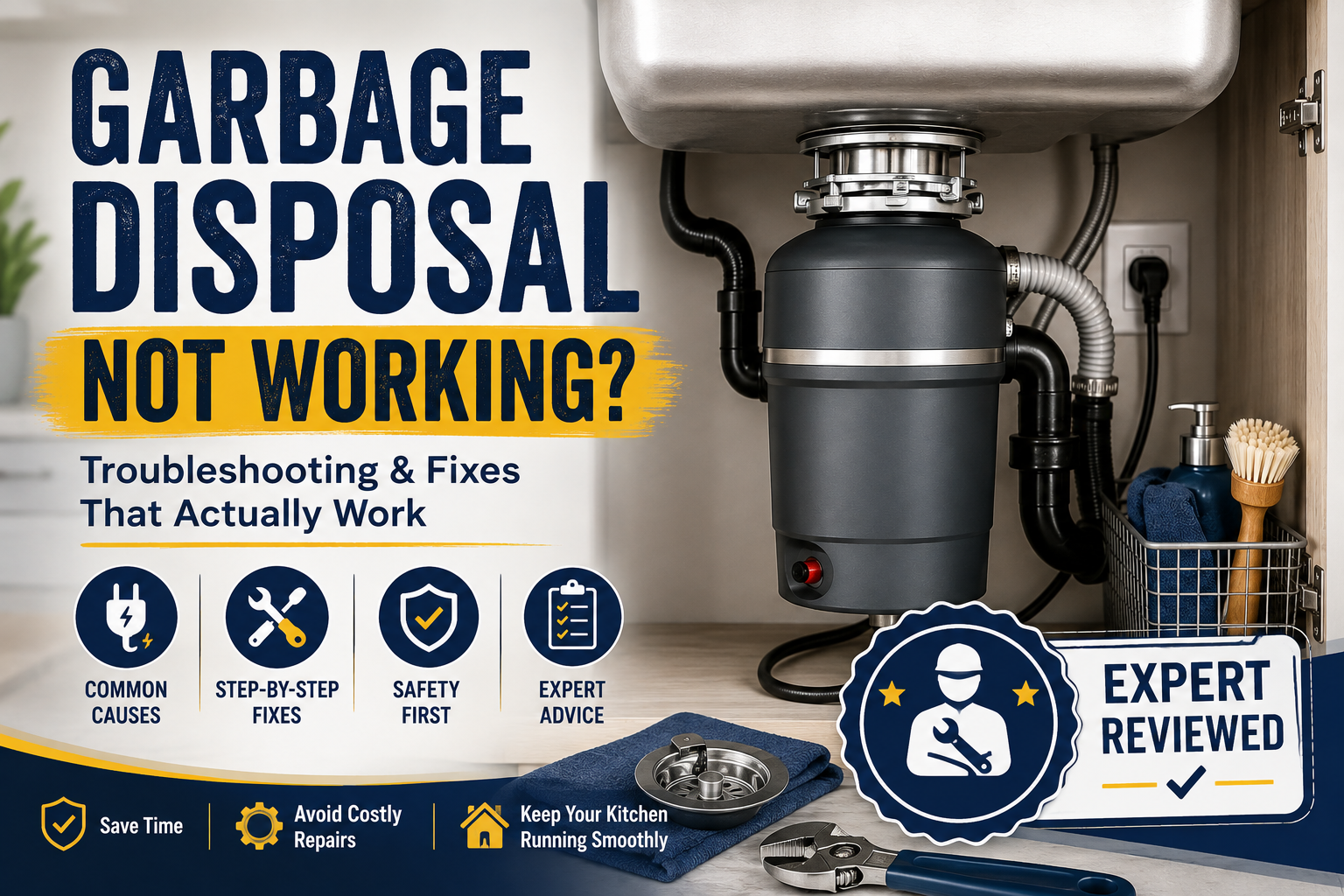
This guide was reviewed by Don Meier, a U.S.-based Master Plumber with hands-on experience in residential plumbing and home maintenance. The review focused on the accuracy of the troubleshooting steps, common causes of garbage disposal problems, safety precautions, and situations where homeowners should stop DIY troubleshooting and contact a qualified professional.
If your garbage disposal is not working, the problem is often something simple, such as a tripped reset button, a power issue, or a jam. Before assuming the unit has failed, check the easiest causes first and work through the problem safely.
A disposal may make no sound at all, hum without spinning, run but fail to drain, or suddenly stop during use. Each symptom can point to a different problem. The goal is to identify what the disposal is doing before attempting a fix.
This guide covers 10 common garbage disposal problems, practical troubleshooting steps, and signs that it is safer to call a plumber or electrician. If you enjoy practical home guides, you can also explore more helpful tips in our Home & Living section.
Before You Start: Important Garbage Disposal Safety Steps
The safest way to troubleshoot a garbage disposal is to make sure it cannot start unexpectedly before you inspect it. Even a small obstruction can be dangerous to remove if the unit still has electrical power.
Turn the disposal off at the wall switch first. For closer inspection or any work inside the sink opening, disconnect power according to the unit’s setup, such as unplugging it when safely accessible or turning off the correct circuit breaker.
Never reach into the disposal chamber with your hand. If you need to remove a visible object, use an appropriate tool after confirming the power is disconnected. If you are unsure whether the unit is electrically isolated, stop and contact a qualified professional.
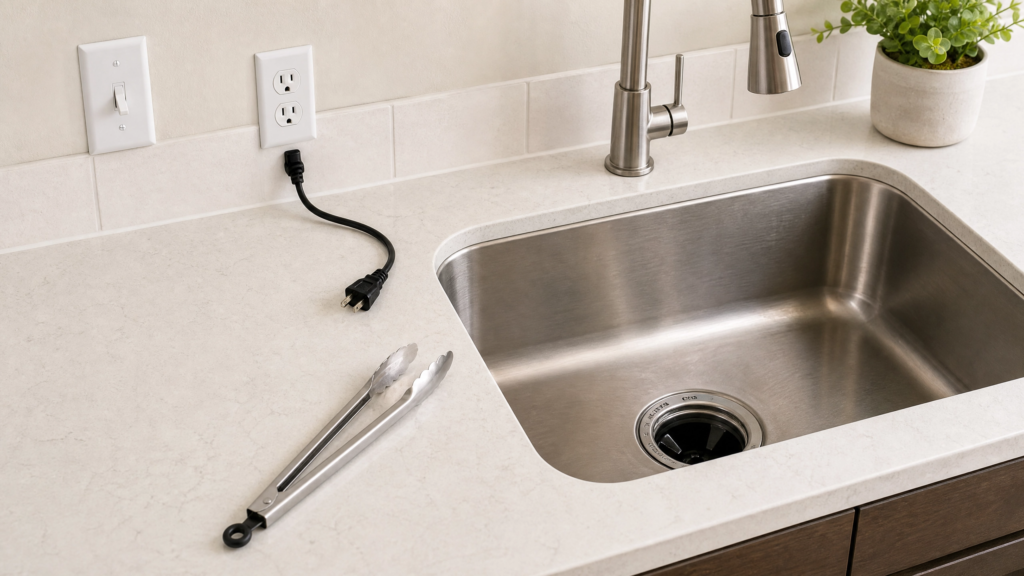
Turn Off the Power Before Inspecting the Disposal
Always treat the disposal as live until you have properly disconnected its power source. Turning off the wall switch alone may not be enough for every inspection or repair situation.
Check your disposal’s installation and manufacturer instructions before performing maintenance. Different models may have specific reset procedures or recommended methods for clearing a jam.
Never Put Your Hand Inside the Garbage Disposal
Your hand should never be used to search for or remove an object inside a garbage disposal. Small bones, utensils, hard food pieces, and other objects can become trapped where they are difficult to see.
If something is visible after the power is disconnected, remove it carefully with suitable tools. If you cannot safely identify or reach the obstruction, it is better to stop than force the unit.
Quick Troubleshooting: Why Is Your Garbage Disposal Not Working?
The sound and behavior of your garbage disposal can give you an important clue about what is wrong. Use the symptom you notice to decide which check makes sense first.
| What You Notice | Possible Problem | What to Check First |
|---|---|---|
| Disposal will not turn on | Power, switch, breaker, reset, or motor problem | Power supply and reset button |
| Disposal hums but will not spin | Possible jam or seized mechanism | Disconnect power and check for an obstruction |
| No sound at all | Power or electrical problem | Outlet, switch, breaker, and reset |
| Disposal runs but sink does not drain | Drain blockage or plumbing issue | Sink drain and connected plumbing |
| Disposal suddenly stopped | Overload, jam, or tripped protection | Reset button and possible obstruction |
Do not assume every symptom has one exact cause. A disposal that will not start, for example, could have a simple reset issue or a more serious electrical or motor problem.
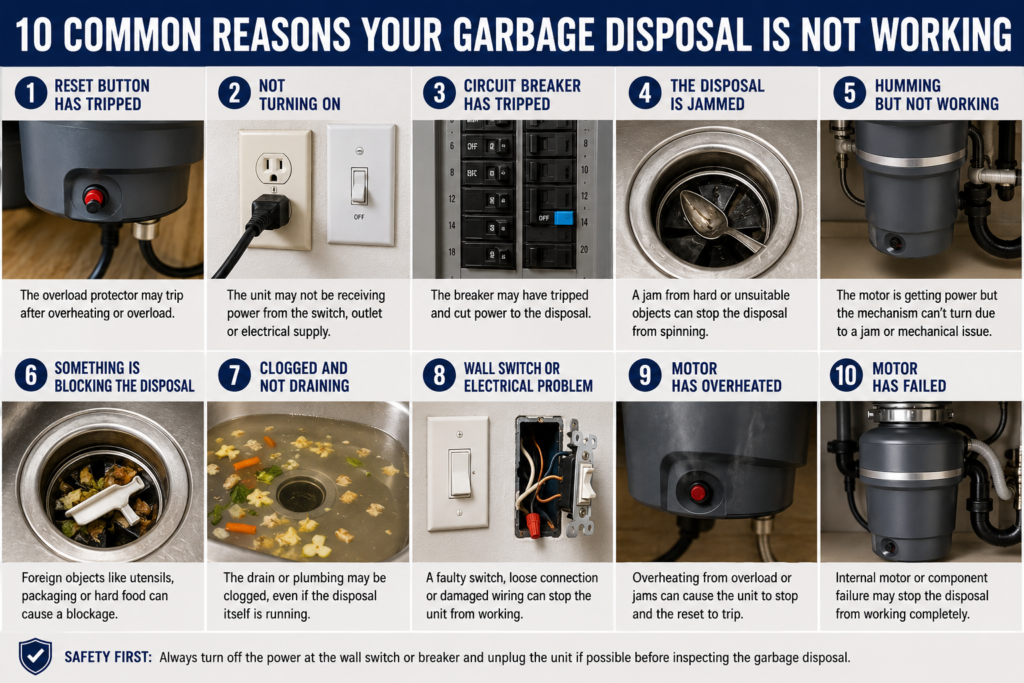
10 Common Reasons Your Garbage Disposal Is Not Working
Most garbage disposal problems fall into a few common categories, including power issues, jams, clogs, overheating, and worn internal parts. Checking these possibilities in a logical order can save time and prevent unnecessary repairs.
1. The Garbage Disposal Reset Button Has Tripped
A tripped garbage disposal reset button can stop the unit from running after it overheats or becomes overloaded. Many disposals have an overload protector with a reset button located near the bottom of the unit.
Before pressing it, allow the disposal to cool if it has recently stopped after heavy use. Follow your manufacturer’s instructions for the correct reset procedure.
If the reset button keeps tripping, do not keep resetting the disposal without finding the cause. Repeated overheating, a jam, or an electrical or motor problem may be involved.
2. The Garbage Disposal Is Not Turning On
If your garbage disposal is not turning on and makes no sound, start by checking whether it is receiving power. Make sure the wall switch is functioning and check the electrical supply according to your installation.
If the unit is plugged into an accessible outlet, check whether the connection is secure. You may also need to check the appropriate circuit breaker.
A food disposal won’t turn on for several reasons, so avoid assuming the motor has failed immediately. Check the simple causes first, including power, the reset button, and the breaker.
3. A Circuit Breaker Has Tripped
A tripped circuit breaker can cut power to the garbage disposal and make the unit appear completely dead. Check your electrical panel and see whether the relevant breaker has tripped.
If resetting the breaker restores power, test the disposal carefully. However, if the breaker trips again, stop using the disposal rather than repeatedly resetting it.
Repeated breaker trips can indicate an electrical fault, an overloaded circuit, or a problem with the appliance. An electrician or other qualified professional may be needed to identify the cause safely.
4. The Disposal Is Jammed
A jam is one of the most common reasons a garbage disposal has power but cannot spin properly. Hard or unsuitable objects can prevent the internal mechanism from moving.
Disconnect the power before checking for an obstruction. Look carefully from above without putting your hand inside the unit.
Some models include a manufacturer-approved method for manually freeing the mechanism. Follow the instructions for your specific disposal rather than forcing the parts with unsuitable tools.
5. Your Garbage Disposal Is Humming but Not Working
A garbage disposal humming but not working often means the motor is receiving power but the internal mechanism is unable to turn freely. A jam is a common possibility, although other mechanical problems can also cause similar symptoms.
Turn the unit off immediately and disconnect the power before inspecting it. Do not leave a humming disposal running, as continued strain can overheat the motor.
If you clear a visible obstruction using a safe, manufacturer-approved method and the disposal still only hums, professional diagnosis may be necessary.
6. Something Is Blocking the Disposal
A foreign object can stop the disposal suddenly, especially when hard or non-food items enter the sink. Utensils, pieces of packaging, hard food scraps, and other unsuitable materials may cause a blockage or jam.
After disconnecting the power, inspect the chamber carefully. Do not force the disposal to run in an attempt to crush an object that does not belong inside.
7. The Garbage Disposal Is Clogged and Not Draining
If the garbage disposal runs but water remains in the sink, the problem may be in the drain rather than the motor. Food waste or other material can collect in the connected plumbing and slow or block drainage.
Avoid assuming the disposal itself is broken simply because the sink is full of water. Check whether other nearby drains are affected and consider whether the blockage is limited to the disposal drain line.
If drainage problems continue, especially with leaks or backups, a plumber can identify where the blockage is located.
8. The Wall Switch or Electrical Connection Has a Problem
A faulty switch or electrical connection can make a working disposal appear completely dead. If the disposal has no sound and basic power checks do not solve the problem, the switch or wiring may need inspection.
Electrical work can create shock or fire risks when done incorrectly. If you suspect damaged wiring, loose electrical connections, or a faulty switch and are not qualified to inspect them safely, contact an electrician.
9. The Motor Has Overheated
An overloaded or jammed disposal may stop after the motor overheats. This is one reason the reset button may trip.
Allow the unit to cool and follow the manufacturer’s instructions before attempting a reset. Check for the cause of the overload rather than immediately returning to normal use.
If overheating happens repeatedly during ordinary use, the disposal may have an underlying mechanical or electrical problem.
10. The Garbage Disposal Motor Has Failed
An older or heavily used disposal may eventually stop working because of internal motor or component failure. If the unit has power, the reset system is functioning, no jam is present, and it still will not operate correctly, replacement or professional repair may be the next step.
A professional can help determine whether repair is practical or whether replacing the disposal makes more sense. This is especially important if the unit also leaks, trips breakers, or shows signs of electrical damage.
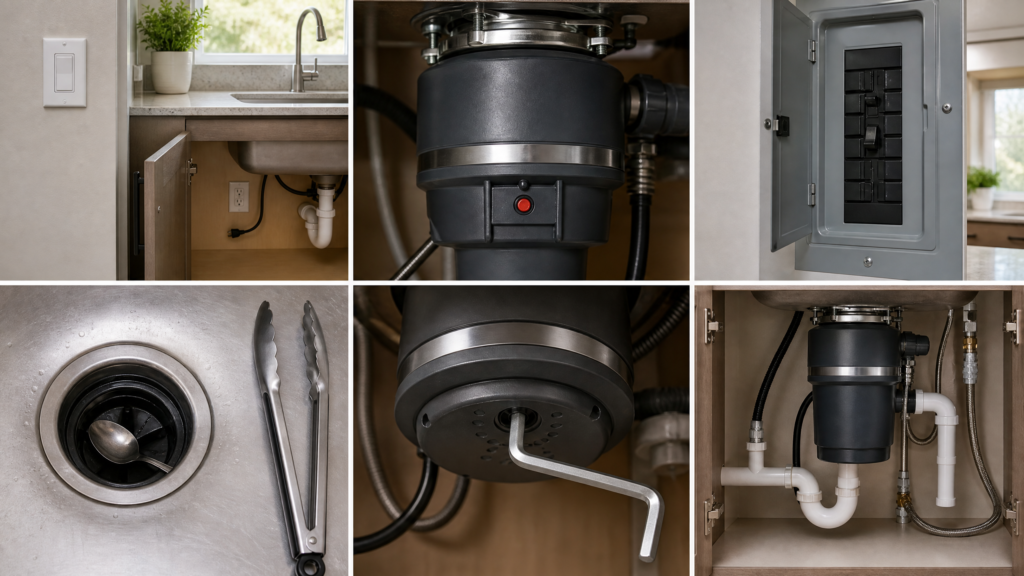
How to Fix a Garbage Disposal That Is Not Working: Step-by-Step
The best troubleshooting method is to start with the easiest and safest checks before moving to more complicated causes. Stop immediately if you notice burning smells, damaged wiring, smoke, or any situation you do not feel safe handling.
Step 1: Check the Power Supply
First, confirm that the disposal can receive power. Check the wall switch and the electrical connection based on how your unit is installed.
Do not remove electrical covers or handle exposed wiring unless you are qualified to do so.
Step 2: Press the Garbage Disposal Reset Button
Next, check whether the overload protector has tripped. If the disposal has recently overheated, allow it to cool and follow the manufacturer’s reset instructions.
After resetting, restore power only when it is safe to do so and test the unit briefly.
Step 3: Check the Circuit Breaker
A breaker check can quickly identify whether the disposal lost power from the electrical panel. If a breaker has tripped, reset it only if there are no signs of an electrical problem.
If it trips again, leave it off and arrange for qualified inspection.
Step 4: Look for a Jam or Obstruction Safely
If the disposal hums or stopped suddenly, a jam is worth checking. Disconnect the power before inspecting the sink opening.
Use appropriate tools to remove a clearly visible object. Never reach into the disposal with your hand.
Step 5: Use the Manufacturer-Approved Unjamming Method
Use only the clearing method recommended for your specific disposal model. Some units are designed to be manually turned using a tool in a designated opening, while procedures vary by manufacturer.
Do not improvise with excessive force. If the mechanism will not move or you cannot safely identify the problem, stop and seek professional help.
Step 6: Test the Disposal Again
After completing the relevant checks, test the disposal carefully and listen for unusual behavior. A normal restart does not always mean the underlying cause has disappeared.
If the unit hums again, repeatedly trips the reset button or breaker, leaks, or makes severe grinding noises, further diagnosis is a better option than repeated testing.
Power → Reset Button → Circuit Breaker → Safe Jam Check → Manufacturer-Approved Unjamming Method → Professional Help if Needed.
Garbage Disposal Humming: What Does It Mean?
A garbage disposal humming usually means electricity is reaching the motor, but something may be preventing the internal mechanism from turning normally. A jam is a common reason, but a humming sound does not guarantee that a simple obstruction is the only problem.
Turn the disposal off as soon as you hear continuous humming without normal operation. Then disconnect the power before checking for an obstruction.
If the mechanism cannot be freed using the procedure recommended by the manufacturer, or the disposal continues humming after safe troubleshooting, the motor or internal components may need professional inspection.
Do not keep switching a humming disposal on and off repeatedly. This can place additional stress on the motor.
Garbage Disposal Still Not Working After Reset? What to Do
If your garbage disposal still does not work after resetting it, the problem may be somewhere else in the troubleshooting process. Check whether the unit has power, whether the circuit breaker has tripped, and whether a jam is preventing the mechanism from turning.
A reset button that immediately trips again or fails to solve the problem can point to repeated overheating or another fault. Likewise, a disposal that remains completely silent may have a switch, wiring, power supply, or internal issue.
At this stage, avoid repeatedly pressing the reset button and repeatedly trying to start the unit. Continued troubleshooting without identifying the cause may create additional damage or hide an electrical problem.
When Should You Call a Plumber or Electrician?
Professional help is the safest choice when the problem involves electrical danger, serious leaks, or a disposal that does not respond to normal troubleshooting. Knowing when to stop DIY troubleshooting is an important part of safe home maintenance.
Call a Professional If You Notice These Warning Signs
Stop using the garbage disposal and consider professional help if you notice any of the following:
- A burning smell, smoke, or visible electrical damage
- The circuit breaker repeatedly trips
- The disposal repeatedly overheats or trips the reset button
- The unit hums but cannot be safely freed
- Water is leaking from the disposal body or electrical area
- Wiring or the wall switch appears damaged
- The disposal has severe grinding or mechanical noises
- The unit still does not work after basic, safe troubleshooting
- You are unsure how to safely disconnect or inspect the unit
For other practical home maintenance topics, you may also find our guides on water returning to a crawl space, cracks in ceilings, and different types of wall cracks useful.
How to Prevent Your Garbage Disposal From Stopping Working Again
Good everyday habits can reduce the chance of jams, overloads, and avoidable disposal problems. Prevention starts with using the appliance only for materials it is designed to handle.
Follow the manufacturer’s guidance about what can and cannot go into your specific disposal. Avoid overloading the unit, and do not assume every type of food waste is suitable simply because it is biodegradable.
Use water and operate the disposal according to the manufacturer’s instructions. Address unusual humming, repeated stopping, or changes in sound early rather than waiting for the unit to fail completely.
Keeping the kitchen organized can also make everyday maintenance easier. For more practical organization ideas, see our guides on how to organize desk drawers and how to organize a bathroom cabinet.
Garbage Disposal Not Working: Key Takeaway
When a garbage disposal stops working, begin with the simplest possible checks instead of immediately assuming you need a new unit. Check the power supply, reset button, and circuit breaker, then investigate a possible jam using safe procedures.
A garbage disposal humming but not working often deserves special attention because the mechanism may be stuck. Turn it off rather than allowing it to continue humming.
If basic troubleshooting does not solve the problem, or you notice electrical warning signs, repeated breaker trips, overheating, serious leaks, or possible motor failure, professional help is the safer choice.
For more ideas and practical guides covering everyday home topics and beyond, visit Daily Idea Book or browse our latest articles in the Blog section.
Editorial & Safety Note
This guide is provided for general educational and informational purposes. Garbage disposal troubleshooting may involve electrical and mechanical hazards, so always disconnect power before inspection and follow your manufacturer’s instructions. Never put your hand inside the disposal, and stop DIY troubleshooting if you notice burning smells, damaged wiring, repeated breaker trips, or any issue you cannot safely handle. When in doubt, contact a qualified plumber or electrician.
Frequently Asked Questions
How to fix garbage disposal humming but not working?
A humming garbage disposal is often jammed, so turn it off immediately and disconnect the power before checking it. Remove any visible obstruction using appropriate tools—never your hand—and use the manufacturer-approved unjamming method for your model. If it still hums after the jam is cleared, or you smell burning, stop using it and contact a qualified professional.
Why is my garbage disposal not turning on?
A garbage disposal that does not turn on may have a tripped reset button, power problem, tripped circuit breaker, faulty switch, or motor issue. Check the power supply, reset button, and circuit breaker first. If the unit still has no response, avoid electrical repairs unless qualified and have the switch, wiring, or disposal inspected.
Why would the garbage disposal suddenly stop working?
A garbage disposal can suddenly stop because of an overload, overheating, a jam, a tripped reset button, or a power problem. Let the unit cool if it overheated, then safely check the reset button and power supply. If it stopped while making unusual noises or repeatedly stops, further inspection may be needed.
How do I reset a garbage disposal?
Most garbage disposals have a reset button on the bottom of the unit. Turn the disposal off, allow it to cool if necessary, locate the reset button, and press it according to the manufacturer’s instructions. Then restore power and test the unit. If the reset button will not stay in or keeps tripping, stop repeatedly resetting it and investigate the cause.
Can you still use your sink if the garbage disposal is not working?
You can often still use the sink, but do not run the disposal or put food waste into the drain until the problem is resolved. If water is draining normally, use the sink carefully and dispose of food scraps elsewhere. If the sink is clogged, backing up, or leaking, limit use until the drainage problem is fixed.
What should I do if my food disposal won’t turn on?
Start by checking the wall switch, power supply, reset button, and circuit breaker. If the food disposal still won’t turn on, disconnect power before checking for a possible jam. Do not handle wiring unless you are qualified, and contact a professional if there are repeated breaker trips, burning smells, damaged wiring, or signs of motor failure.
Sources & References
This guide uses manufacturer instructions and trusted electrical safety resources. Always follow the guidance for your specific garbage disposal model.
- InSinkErator Product Support — Product instructions and troubleshooting guidance.
- U.S. CPSC: Electrical Safety — General electrical safety guidance.
- CPSC: National Electrical Code Information — Electrical safety standards information.
Important: Always disconnect power before inspecting a garbage disposal. Stop and contact a qualified professional if you notice damaged wiring, repeated breaker trips, burning smells, or smoke.