
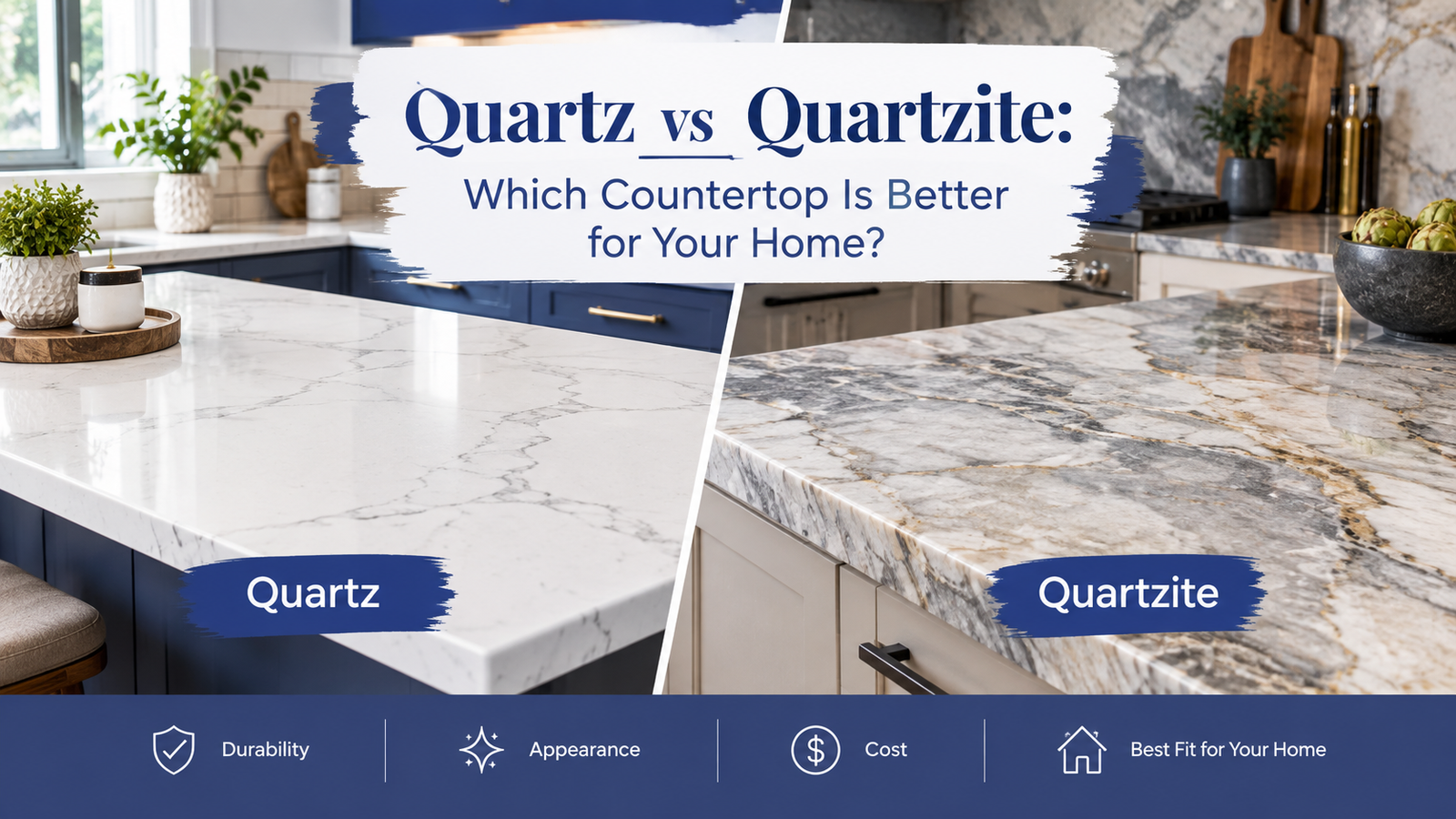
Quartz and quartzite may sound almost identical, but they are two different countertop materials with different properties, care requirements, and appearances. Quartz is an engineered countertop material made using quartz minerals, resins, and pigments, while quartzite is a natural stone formed by heat and pressure.
For most homeowners, quartz is the easier choice if low maintenance is the priority. Quartz does not normally require sealing and offers a wide range of colors and patterns. Quartzite can be the better choice if you want the natural variation of real stone and are comfortable with more care.
The right choice depends on more than appearance. Your cooking habits, budget, tolerance for maintenance, design preferences, and how you use your kitchen should all be part of the decision.
If you are also planning a kitchen update, our guide to kitchen remodel ideas can help you think about the countertop alongside cabinets, layout, lighting, and other finishes.
Quartz vs Quartzite: What’s the Difference?
The biggest difference is simple: quartz countertops are engineered, while quartzite countertops are made from natural stone. That difference affects their appearance, maintenance, fabrication, and everyday use.
Quartz countertops are manufactured from ground quartz minerals combined with binders, resins, and pigments. Because the material is engineered, manufacturers can create a wide variety of colors and patterns, including designs that resemble marble and natural stone.
Quartzite is a natural metamorphic rock created when quartz-rich sandstone or similar rock is changed by heat and pressure over time. Natural slabs are cut and finished for use as countertops.
That distinction is important when shopping because a countertop called “quartz” is not the same thing as quartzite, even though both contain a large amount of quartz mineral.
Quartz vs Quartzite at a Glance
| Feature | Quartz | Quartzite |
|---|---|---|
| Material | Engineered stone | Natural stone |
| Appearance | Consistent and highly customizable | Naturally varied |
| Maintenance | Low | Moderate |
| Sealing | Generally not required | Often recommended, depending on the stone |
| Stain resistance | Generally excellent | Depends on the stone and its protection |
| Scratch resistance | Good | Generally very good |
| Heat resistance | Good, but heat protection is recommended | Generally better suited to heat |
| Pattern | Controlled and repeatable | Unique natural movement |
| Cleaning | Mild soap and water | Mild stone-safe cleaner |
| Best for | Low-maintenance kitchens | Natural-stone appearance and character |
Quartz Countertops: Pros and Cons
Quartz is popular because it combines a polished appearance with relatively simple everyday care.
Because quartz is engineered, manufacturers have considerable control over its color, pattern, and finish. This makes it easier to find a countertop that works with modern, traditional, minimalist, or transitional kitchens.
Quartz is also nonporous, so it does not absorb liquids in the same way porous natural stone can. That makes everyday cleanup relatively straightforward. Manufacturers generally recommend routine cleaning with mild soap and water or an appropriate mild cleaner.
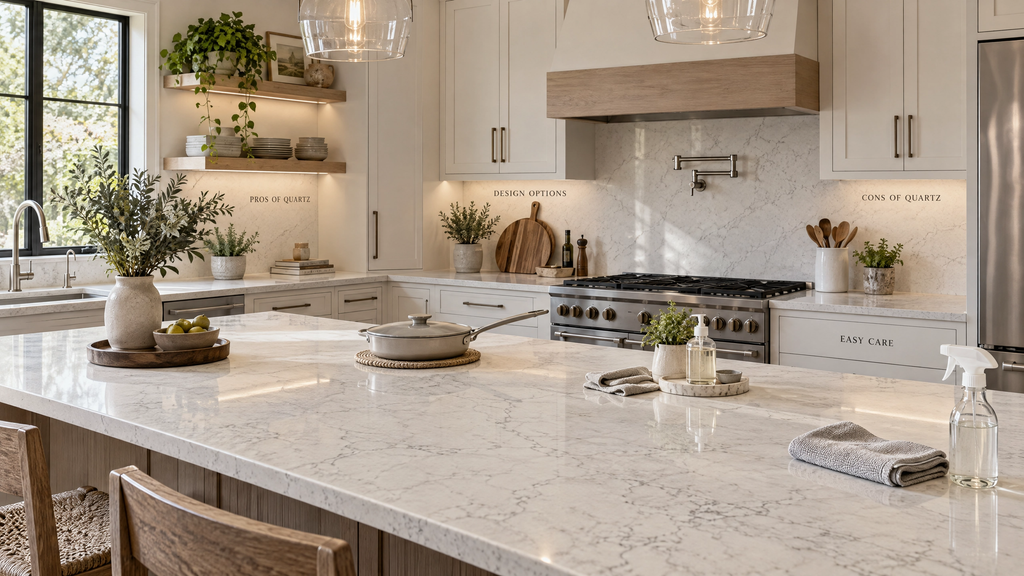
Pros of Quartz
Low maintenance is one of quartz’s biggest advantages.
- Usually does not require regular sealing
- Easy to clean
- Available in many colors and patterns
- Can mimic the look of marble and other natural stones
- Consistent appearance across a project
- Good resistance to everyday staining
- Well suited to busy indoor kitchens
Quartz can be particularly convenient for households where the kitchen gets heavy daily use. If you regularly prepare meals, have children, entertain guests, or simply do not want another surface to maintain, its low-maintenance nature can be valuable.
Cons of Quartz
Quartz is not completely maintenance-free, and its biggest limitation is heat.
Although quartz countertops are durable, they should not be treated as heat-proof surfaces. Manufacturers commonly recommend using trivets or heat pads rather than placing very hot cookware directly on the countertop.
Other potential disadvantages include:
- Higher cost than some budget countertop materials
- Manufactured appearance may not appeal to natural-stone lovers
- Repeated patterns can sometimes be noticeable across a large installation
- Heavy impact can still cause chips or damage
- Certain cleaning products may damage the surface
The last point is easy to overlook. A durable countertop still benefits from sensible care. Avoid harsh or abrasive products unless the manufacturer specifically says they are suitable.
If you’re coordinating your quartz countertop with other kitchen surfaces, you may also want to see our guide to kitchen backsplash ideas for ideas on combining countertop colors, cabinets, and backsplash materials.
Quartzite Countertops: Pros and Cons
Quartzite stands out when the natural character of stone is more important than having the easiest possible maintenance routine.
Every natural slab can have its own movement, veining, color variation, and mineral pattern. This is one of the main reasons homeowners choose quartzite when they want their kitchen to have a more natural and distinctive appearance.
Quartzite is also a hard natural stone, which makes it attractive for high-use countertop applications. However, hardness does not mean that every quartzite slab behaves exactly the same way.
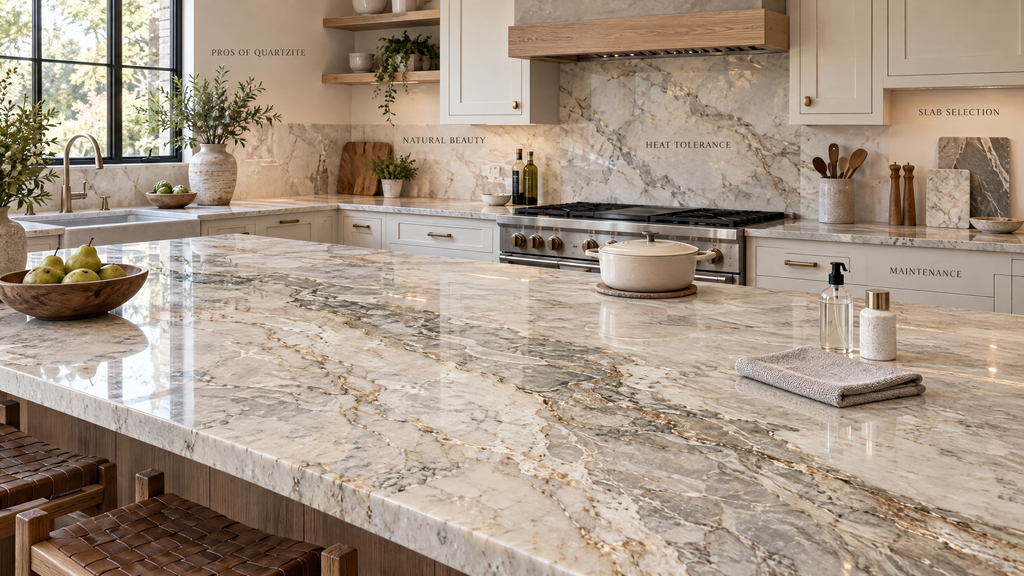
Pros of Quartzite
The natural appearance is often quartzite’s biggest selling point.
- Unique natural patterns
- Strong and durable surface
- Excellent choice for natural-stone aesthetics
- Good resistance to everyday wear
- Generally better heat tolerance than engineered quartz
- Can create a high-end, one-of-a-kind appearance
Quartzite can be especially appealing if you have visited a stone yard and fallen in love with a particular slab. In that situation, the exact slab may be more important to you than having a perfectly consistent pattern.
Cons of Quartzite
The trade-off for natural beauty is usually more maintenance and more attention during selection.
Many quartzite countertops benefit from an appropriate penetrating treatment to improve stain resistance, although the exact maintenance requirement depends on the particular stone. The Natural Stone Institute notes that sealing or impregnating does not make stone completely stain-proof; it helps make it more stain-resistant.
Potential drawbacks include:
- May require periodic resealing or treatment
- Natural variation can make matching slabs difficult
- Some stones are more porous than others
- Spills should be cleaned promptly
- Fabrication can be more involved depending on the slab and design
- Premium or unusual slabs can be expensive
Do not assume that every slab sold as quartzite will have exactly the same maintenance needs. Ask the stone supplier whether the particular slab needs sealing, how often it should be checked, and what type of cleaner is recommended.
Quartz vs Quartzite: Which Is More Durable?
Both can be durable countertop choices, but durability means more than simply asking which stone is harder.
Quartzite is a hard natural stone and can perform very well against everyday scratching and wear. Quartz is also designed for demanding indoor countertop use, but it has different characteristics because of its engineered composition.
The type of damage matters too.
A countertop can be resistant to scratches but still be vulnerable to edge chips, impact damage, thermal shock, or incorrect installation. This is why simply saying one material is “stronger” does not tell the whole story.
For example, a heavy object dropped directly on a countertop edge can cause damage even when the surface itself is highly durable.
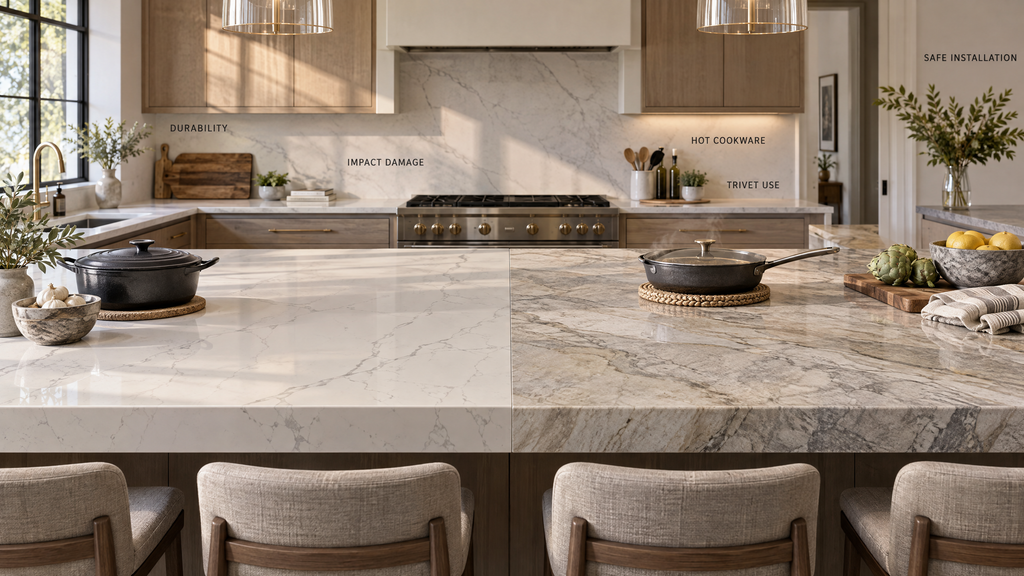
What About Hot Pots and Pans?
Heat is one area where you should be more cautious with quartz.
Quartz manufacturers commonly advise using trivets or heat pads and avoiding direct exposure to very hot cookware.
Quartzite generally has better heat resistance because it is natural stone, but that does not mean you should intentionally use it as a hot plate. Sudden temperature changes, very high heat, or concentrated heat can still create problems depending on the stone and installation.
The safest habit for either countertop is simple: use a trivet for hot cookware.
That small habit can help protect an expensive countertop regardless of which material you choose.
Quartz vs Quartzite: Which Is Easier to Maintain?
Quartz wins the maintenance comparison for most homeowners because it normally does not require routine sealing.
For everyday quartz care, wipe up spills, clean the surface with a suitable mild cleaner, and follow the manufacturer’s care instructions.
Quartzite requires a little more attention because natural stone can be porous. The effectiveness and lifespan of a stone treatment depend on the specific material and product used.
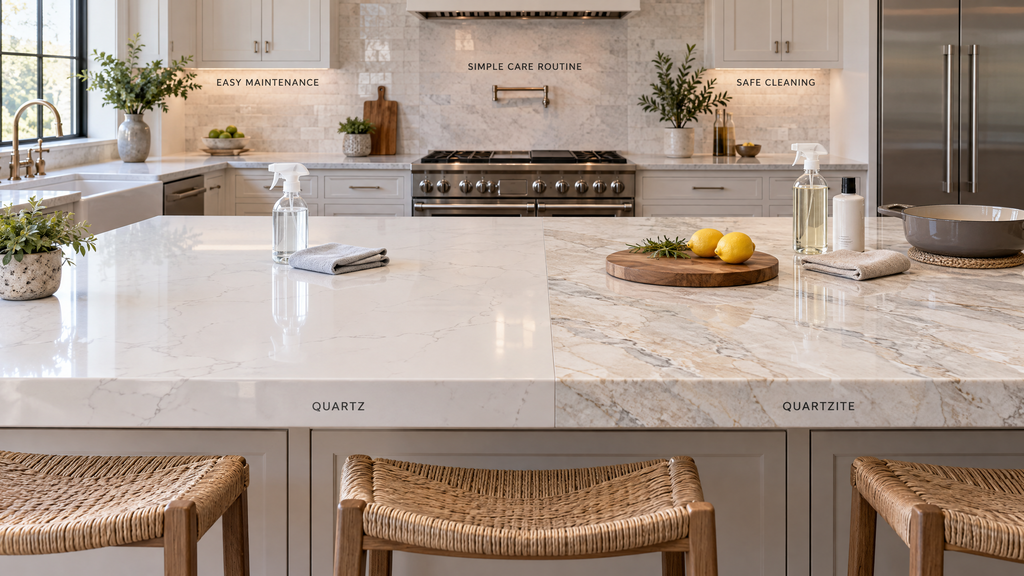
Simple Care Routine
A few basic habits can keep either countertop looking better for longer.
For quartz:
- Wipe spills rather than allowing them to sit unnecessarily.
- Use mild soap and water or the manufacturer’s recommended cleaner.
- Use a cutting board instead of cutting directly on the surface.
- Use trivets under hot cookware.
- Avoid abrasive cleaners unless specifically approved.
For quartzite:
- Wipe spills promptly.
- Use a cleaner intended for natural stone.
- Avoid harsh acids and abrasive products.
- Follow the supplier’s sealing recommendations.
- Use cutting boards and trivets.
- Ask the fabricator how to care for your specific slab.
The Natural Stone Institute warns that certain acids, abrasive cleaners, and hydrofluoric-acid-containing products can damage natural stone, including quartzite.
One of the biggest mistakes is assuming that “natural stone” means you can clean it with anything. Stone care depends on the material and the cleaner, so the manufacturer’s or stone supplier’s instructions should take priority.
Quartz vs Quartzite: Which Costs More?
There is no single price winner because countertop cost depends heavily on the slab, brand, edge profile, fabrication, installation, location, and project complexity.
Published manufacturer estimates show that both materials can occupy a broad price range, so a simple “quartz is always cheaper” or “quartzite is always more expensive” statement can be misleading.
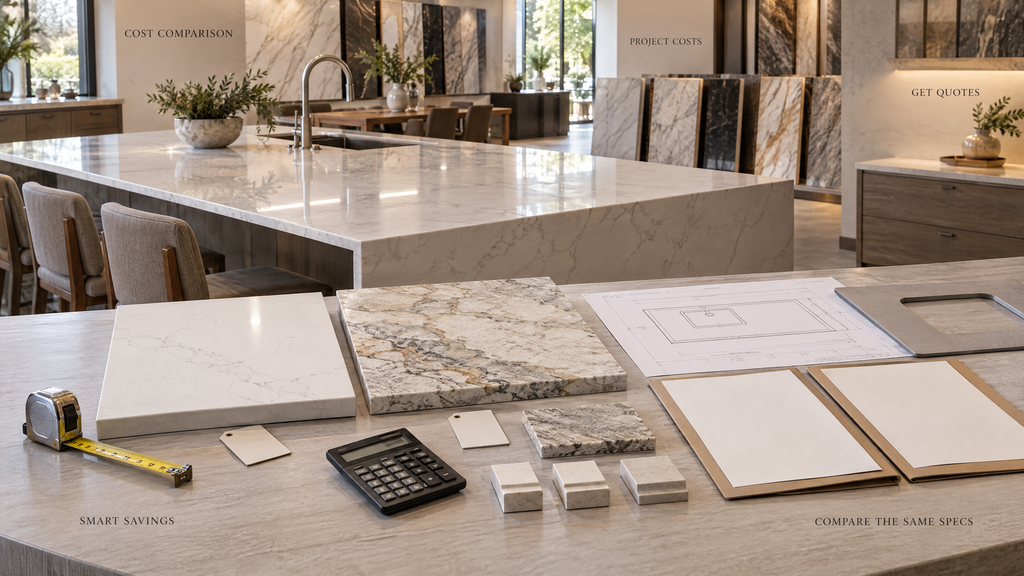
Your final project price may include:
- Countertop material
- Slab selection
- Measuring
- Template creation
- Cutting and fabrication
- Edge treatment
- Sink cutouts
- Cooktop cutouts
- Delivery
- Installation
- Sealing or stone treatment
- Removal of an existing countertop
The best way to compare prices is to request quotes for the same countertop layout and specifications.
For example, comparing a standard quartz slab with a premium natural quartzite slab does not give you a useful material comparison if one project also has a more complicated edge, larger island, or additional fabrication.
How to Save Money Without Choosing the Cheapest Material
The smartest savings usually come from simplifying the project rather than choosing the lowest-quality countertop.
Consider:
- Comparing several slab options
- Choosing a simpler edge profile
- Limiting unnecessary seams
- Keeping the island design practical
- Comparing fabrication and installation quotes
- Looking at remnant pieces for smaller surfaces
- Choosing a pattern that does not require excessive slab matching
Quartz vs Quartzite: Appearance and Design
Choose quartz if you want design control; choose quartzite if you want the individuality of natural stone.
Quartz can provide a consistent look throughout a kitchen. This can be useful when you want clean lines or a predictable pattern across a large island.
Quartzite offers natural movement that cannot be perfectly reproduced from one slab to another. Veining can vary considerably, which can make the finished countertop feel more distinctive.
Neither approach is automatically better.
If you want your kitchen to have a highly controlled appearance, quartz may make more sense. If you want the countertop itself to be a natural focal point, quartzite may be more appealing.
Your countertop should also work with your other finishes. If you’re remodeling more than the kitchen, our guide to bathroom remodel ideas shows how material selection can affect the overall style and budget of a renovation.
Quartz vs Quartzite: Which Is Better for Your Home?
| If your priority is… | Consider… | Why |
|---|---|---|
| Low maintenance | Quartz | No routine sealing is normally required |
| Natural appearance | Quartzite | Each slab has natural variation |
| Consistent pattern | Quartz | Engineered designs are more predictable |
| Heat resistance | Quartzite | Natural stone generally handles heat better |
| Easy everyday cleaning | Quartz | Nonporous surface and simple routine |
| Unique slab | Quartzite | Natural patterns vary from slab to slab |
| Busy family kitchen | Quartz | Less routine maintenance |
| Design flexibility | Quartz | Wide range of colors and patterns |
| Natural-stone character | Quartzite | Genuine stone movement and variation |
Think about how you actually use your kitchen rather than choosing based only on a showroom sample.
If your family cooks several times a day, leaves spills for a while, and does not want another maintenance task, quartz may fit your lifestyle better.
If you are comfortable caring for natural stone and your main goal is a distinctive slab with natural movement, quartzite may be the better fit.
How to Choose Between Quartz and Quartzite
The best countertop is the one that matches your habits, not simply the one that looks best in a showroom.
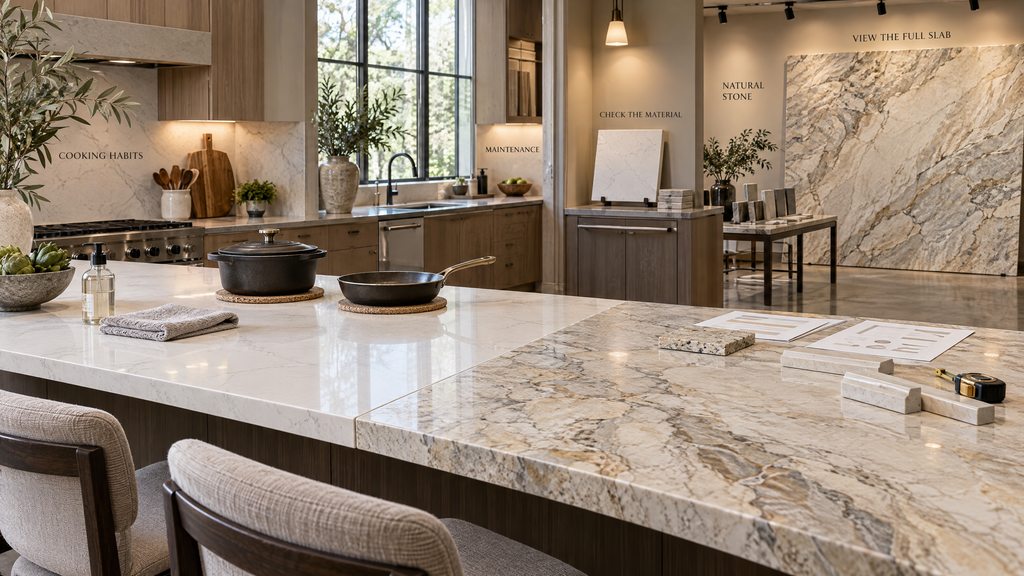
Before ordering, work through these questions:
1. How Much Maintenance Are You Comfortable With?
Choose quartz if you want to keep countertop maintenance as simple as possible.
Quartz is generally the easier option for homeowners who do not want to think about sealing or stone-specific maintenance.
2. How Important Is Natural Stone?
Choose quartzite if the natural character of a real stone slab is a major part of your design goal.
Visit a stone yard and look at full slabs rather than choosing only from a small sample.
3. How Do You Cook?
Frequent cooks should pay particular attention to heat protection and spill management.
If you regularly move hot pans directly from the oven or cooktop onto the counter, change that habit regardless of which material you choose.
4. Are You Comparing the Actual Materials?
Always confirm exactly what you are buying before comparing prices or performance.
Ask:
- Is this genuine quartzite?
- Does this slab need sealing?
- What cleaning products are safe?
- How often should it be resealed?
- How does the manufacturer rate the quartz surface?
- What warranty is included?
- How will seams be positioned?
- What edge profile is recommended?
5. Have You Looked at the Full Slab?
A small sample cannot always show how natural stone will look across an entire island.
Quartz can also have repeating patterns, so viewing larger samples or slabs is useful when the countertop is going to cover a large area.
A Common Mistake: Choosing Quartzite Without Testing the Specific Slab
The name “quartzite” alone does not tell you everything about a stone’s maintenance needs.
Natural stone varies, and homeowners should ask the supplier about the exact slab rather than assuming every quartzite behaves identically.
This matters particularly when you are attracted to a very specific white or marble-like stone. Some stones sold in the marketplace can be misidentified or classified differently, so ask the stone yard for the material’s exact identification and care recommendations.
If possible, ask whether the slab can be tested for absorption and staining before you commit to it.
That extra step can prevent disappointment after installation.
What Homeowners on Reddit Say About Quartz vs Quartzite
One of The Reddit discussion shows why there is no universal winner between quartz and quartzite.
In the r/kitchenremodel discussion, the original poster was concerned about choosing between the natural appearance of quartzite and the easier maintenance of quartz, particularly with young children.
The responses were divided.
Some homeowners strongly preferred quartz because they valued low maintenance, no routine sealing, and easier everyday care. One commenter described having quartz for several years while dealing with children, spills, and heavy household use without major problems. Others specifically mentioned choosing quartz because they did not want to worry about resealing natural stone.
Other commenters preferred genuine quartzite because they felt the natural stone looked better and performed well in their kitchens. One homeowner mentioned using Taj Mahal quartzite in a busy kitchen and being happy with it while keeping up with sealing.
There were also comments about quartz surfaces developing scratches, chips, or heat-related damage, showing that “low maintenance” does not mean “impossible to damage.” These are individual experiences, not controlled product tests, so they should not be treated as proof that one material always performs better.
Our Take on the Discussion
The most useful lesson from the Reddit conversation is that the exact product and your lifestyle matter more than the label alone.
If you have a busy household and want minimal maintenance, quartz is a sensible starting point.
If you care strongly about natural stone and are willing to follow its care requirements, a properly selected quartzite can be an excellent countertop.
The discussion also highlights an important shopping step: look at the actual slab, ask questions at the stone yard, and understand its care requirements before purchasing.
Reddit can be useful for learning about real-world experiences, but individual comments should not replace manufacturer instructions or advice from a qualified countertop fabricator.
Final Verdict: Quartz or Quartzite?
For the average homeowner who wants a durable, attractive countertop with minimal maintenance, quartz is the easier overall choice.
It offers a wide range of styles, a nonporous surface, simple everyday cleaning, and generally no need for routine sealing.
Quartzite is the better choice when natural stone character is a top priority and you are comfortable with additional care. Its natural veining and variation can create a countertop that feels more distinctive, while its stone composition makes it attractive for homeowners who want genuine natural material.
The smartest approach is not to ask only, “Which is better: quartz or quartzite?”
Instead, ask:
“Which one better fits the way I cook, clean, budget, and use my kitchen?”
For a busy household that values convenience, quartz will often make more sense. For someone who loves the look and feel of natural stone and does not mind proper maintenance, quartzite can be an excellent investment.
Whichever you choose, compare the actual product, review the care instructions, inspect the slab, and get a detailed fabrication and installation quote before making the final decision.
Quartz vs Quartzite: Common Questions
Is quartz better than quartzite?
Quartz is better for homeowners who prioritize low maintenance and consistent design, while quartzite may be better for homeowners who prioritize natural stone appearance and heat resistance.
There is no single answer that applies to every kitchen.
Is quartzite more durable than quartz?
Quartzite is a very hard natural stone, but overall countertop durability depends on more than hardness.
Installation quality, slab characteristics, edge design, impact, heat exposure, and maintenance all matter.
Does quartzite need to be sealed?
Many quartzite countertops benefit from a suitable stone treatment, but the exact requirement depends on the specific slab.
Ask the stone supplier about absorption, recommended treatment, and maintenance intervals rather than assuming every quartzite needs the same schedule. The Natural Stone Institute also notes that sealing improves stain resistance rather than making stone completely stain-proof.
Can you put hot pans on quartz?
It is better to use a trivet or heat pad rather than placing very hot cookware directly on quartz.
Quartz manufacturers commonly recommend protecting the surface from direct heat.
Is quartz easier to clean than quartzite?
Yes, quartz is generally easier to maintain because it is nonporous and normally does not require routine sealing.
Quartzite can also be easy to clean, but it requires more attention to the stone’s specific care and protection requirements.
Does quartz look like real stone?
Modern quartz can closely imitate the appearance of natural stone, but the visual effect is not identical to every natural quartzite slab.
If natural variation is important to you, compare full slabs rather than relying only on small samples.