
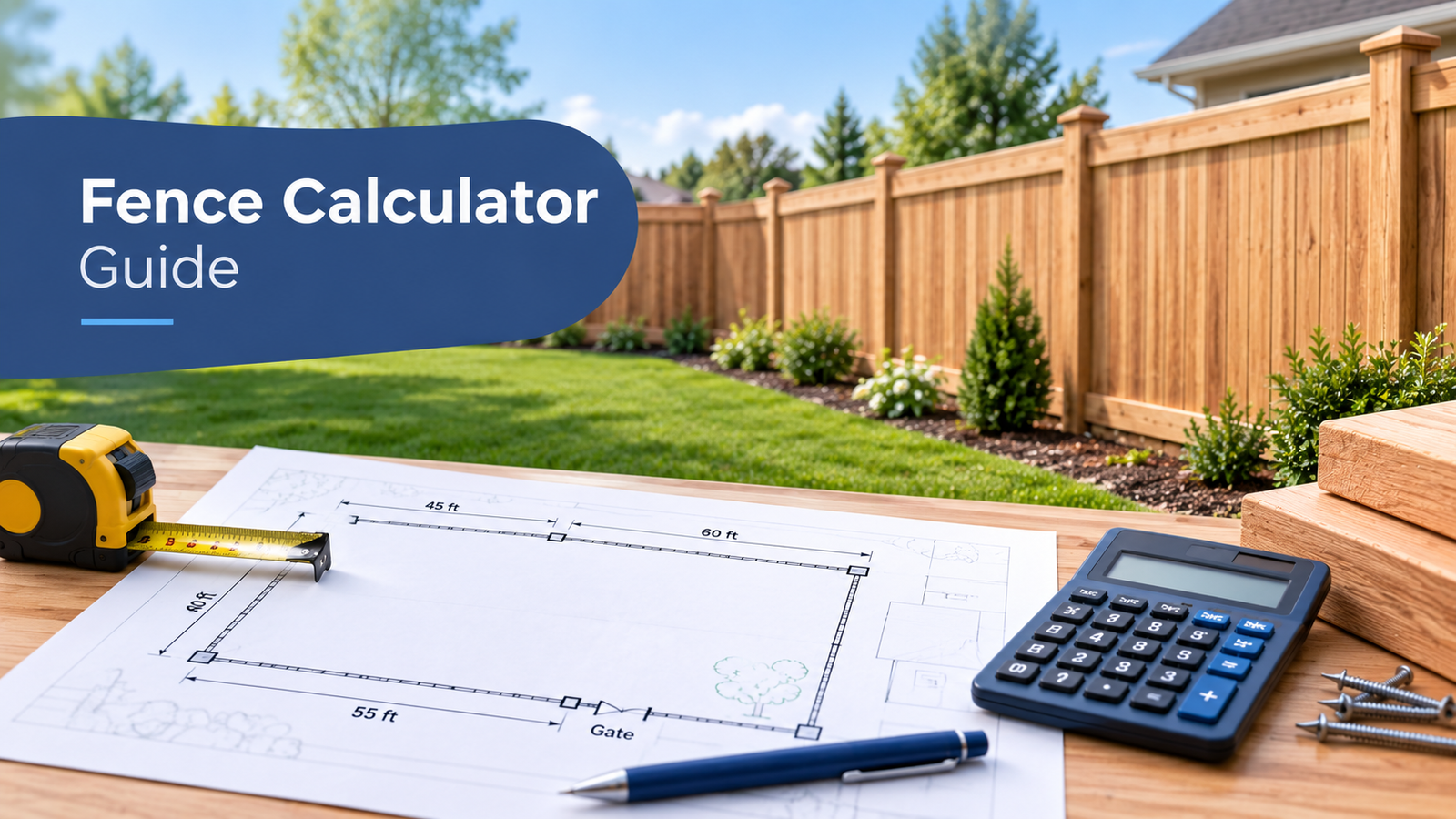
A fence project can look simple until you start figuring out how many posts, panels, pickets, bags of concrete, and gates you actually need. A homeowner may know the yard needs a 6-foot fence, but that alone doesn’t tell you how much material to buy or what the finished project might cost.
A fence calculator helps turn your measurements into a practical starting estimate. By entering the fence length, height, material, post spacing, and gate information, you can estimate the number of fence sections, posts, panels, pickets, and other materials required.
The important word is estimate. A calculator is useful for planning and budgeting, but the final material takeoff can change because of corners, slopes, gates, manufacturer dimensions, soil conditions, and the actual layout of your property.
The most useful fence estimate starts with a few measurements rather than a guess based on yard size.
Fence Calculator
| Input | Why It Matters |
|---|---|
| Total fence length | Determines the overall amount of fencing |
| Fence height | Affects material quantity, privacy, and cost |
| Fence material | Wood, vinyl, chain link, and aluminum use different components |
| Post spacing | Determines the approximate number of posts and sections |
| Panel or picket dimensions | Determines how many individual pieces are needed |
| Number of gates | Gates require openings, hardware, and additional posts |
| Corners and ends | Change the number and type of posts required |
| Terrain | Slopes and uneven ground can change the material takeoff |
| Waste allowance | Helps account for cuts, damaged pieces, and layout adjustments |
A calculator can then provide an approximate number of:
- Fence sections
- Fence posts
- Fence panels
- Pickets
- Rails
- Concrete
- Other fencing materials
- Gates and related components
- Estimated material cost
- Approximate installation cost
A Simple Fence Calculation Example
Suppose your fence line measures 180 linear feet, and you’re planning posts approximately 8 feet apart.
The basic section calculation is:
180 ÷ 8 = 22.5 sections
Because you can’t install half a fence section, you would round up to approximately 23 sections.
That doesn’t automatically mean you need exactly 23 posts. Corners, ends, and gates affect the actual post count, and the installer may adjust spacing to make the layout work cleanly.
That’s the difference between a basic calculator estimate and a real material takeoff.
Related: LVP vs Laminate Flooring: Pros, Cons, Cost & Key Differences (2026)
What Information Do You Need for a Fence Estimate?
Accurate measurements are more valuable than trying to estimate materials from the size of your property alone.
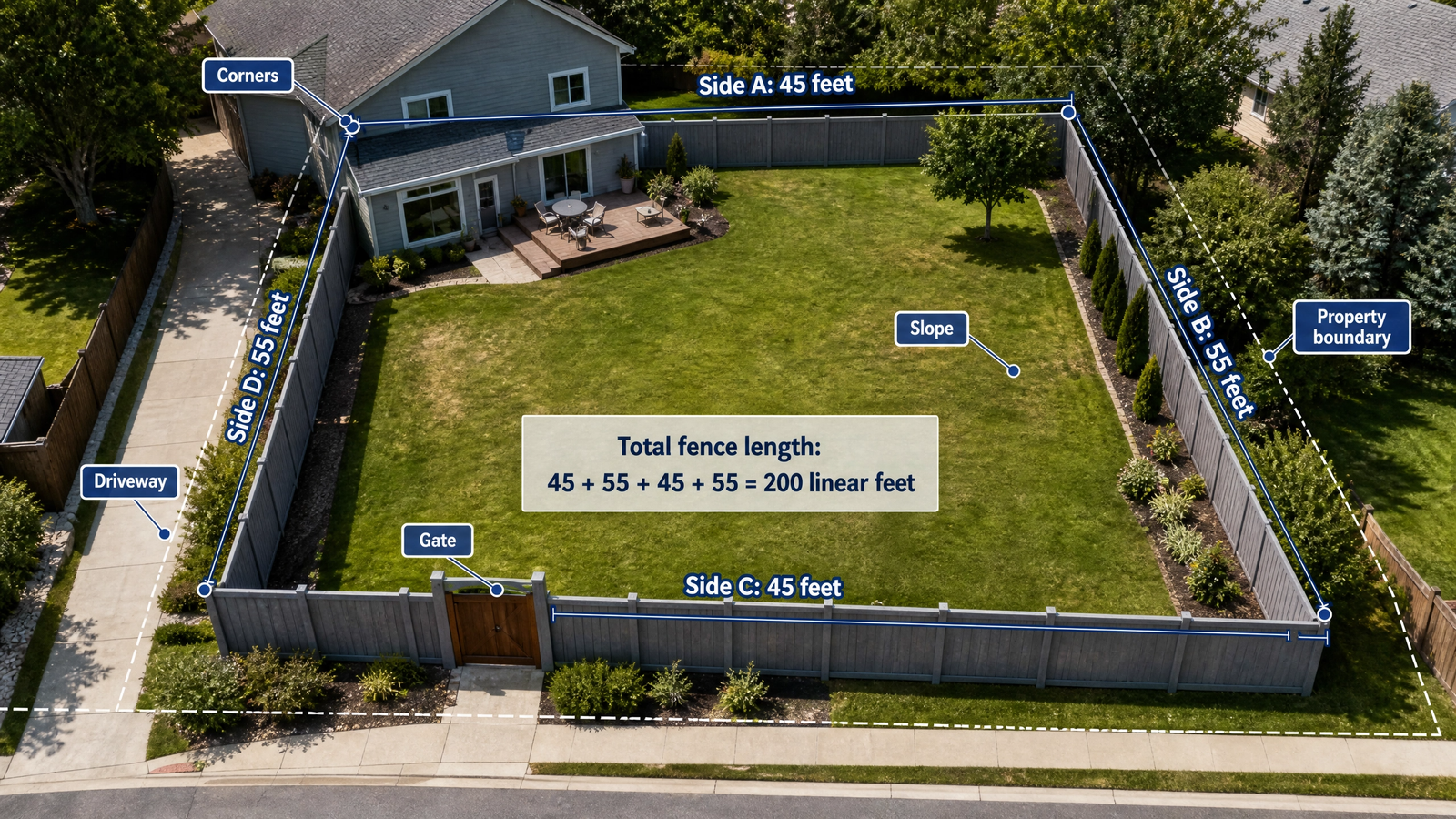
Before calculating, determine the actual length of each fence run. If your yard has four straight sides, measure each side separately and add them together.
For example:
- Side A: 45 feet
- Side B: 55 feet
- Side C: 45 feet
- Side D: 55 feet
Total fence length:
45 + 55 + 45 + 55 = 200 linear feet
You should also mark:
- Corners
- Property-line changes
- Existing structures
- Gate locations
- Driveway openings
- Sloped sections
- Areas where the fence stops or changes direction
If you’re replacing an existing fence, don’t assume the old fence was positioned correctly. Verify the property boundary and local requirements before using the existing layout as your measurement.
How to Calculate Fence Length
Fence length is normally measured in linear feet, not square feet.
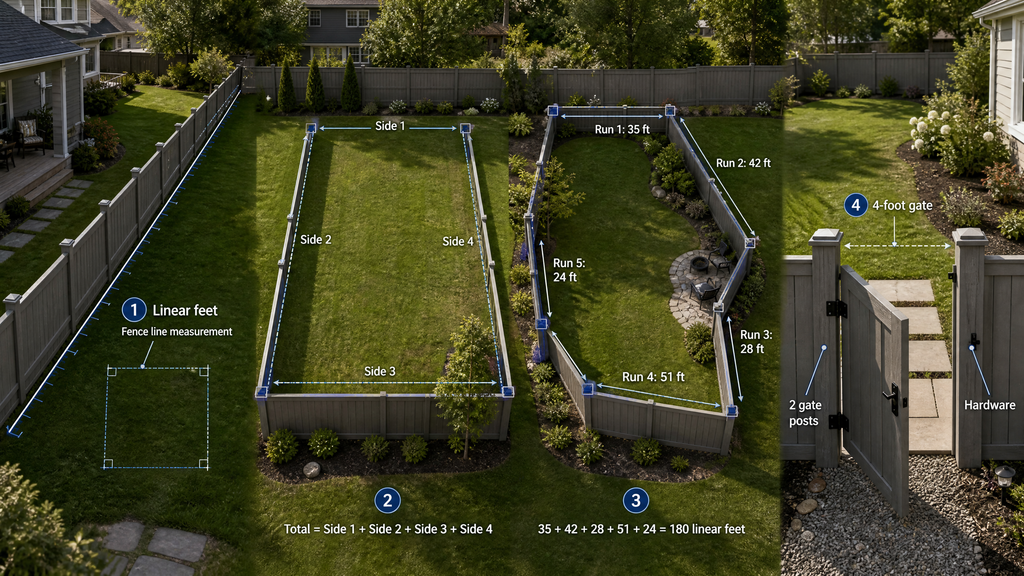
Linear feet describe the distance along the fence line. Square feet describe an area, such as the floor area of a room or the surface area of a wall.
For most residential fencing calculations, you need linear feet.
Measuring a Rectangular Yard
For a simple rectangular area, measure all four sides:
Total fence length = Side 1 + Side 2 + Side 3 + Side 4
You don’t necessarily need to calculate the perimeter from the property’s dimensions if only part of the property will be fenced. Measure the actual proposed fence line instead.
Measuring an Irregular Yard
Irregular yards should be divided into smaller fence runs rather than treated as one large shape.
Measure each straight section between corners or changes in direction.
For example:
- Run 1: 35 feet
- Run 2: 42 feet
- Run 3: 28 feet
- Run 4: 51 feet
- Run 5: 24 feet
Total:
35 + 42 + 28 + 51 + 24 = 180 linear feet
This approach also makes it easier to identify where corner, end, and gate posts are needed.
Don’t Forget Gate Openings
A gate creates an opening in the fence, but that doesn’t necessarily mean you simply subtract its width from every material calculation.
For example, a 4-foot gate may remove roughly 4 feet of continuous fence coverage, but the opening also requires two gate posts and appropriate hardware.
The exact calculation depends on the fence system.
Related: Sheetrock vs. Drywall: What’s the Difference and Which Should You Choose? (2026)
How to Calculate Fence Posts
Post spacing is one of the biggest factors affecting your material estimate.
A simple starting formula is:
Number of fence sections = Total fence length ÷ desired post spacing
Then round up to account for the complete sections required.
However, the final number of posts depends on how those sections connect.
Post Spacing
Common residential fence layouts may use spacing around 6 to 8 feet, but there isn’t one universal spacing rule for every fence.
The correct spacing depends on:
- Fence material
- Fence height
- Panel width
- Wind exposure
- Local requirements
- Manufacturer specifications
- Post size
- Fence design
A taller privacy fence, for example, may place different structural demands on the posts than a shorter decorative fence.
If you’re using prefabricated panels, the panel width often influences the practical post layout.
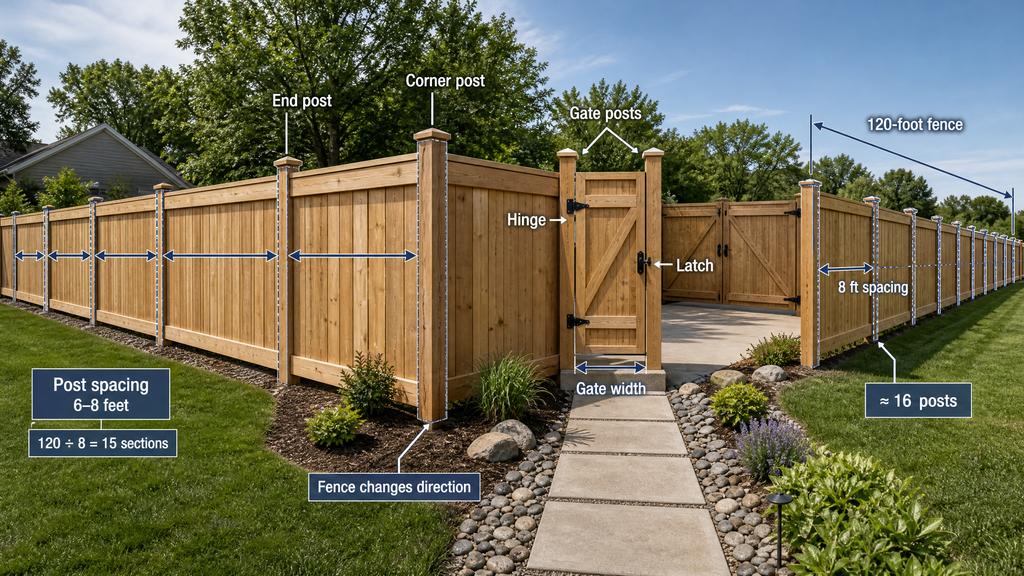
Corner and End Posts
Corners need special attention because one corner can serve two fence runs.
A basic calculator that simply divides the total length by post spacing may miss this detail.
You generally need to identify:
- Starting/end posts
- Ending posts
- Corner posts
- Posts where the fence changes direction
- Gate posts
The exact hardware and post arrangement can vary by fencing system.
Gate Posts
A gate should be treated as a structural part of the fence, not just an opening.
A typical walk gate needs posts on both sides. Wider gates may require larger or more heavily supported posts because the gate creates additional load.
Double gates can require additional considerations, including:
- Gate width
- Hinge configuration
- Latch location
- Gate weight
- Post size
- Ground conditions
This is one reason a fence calculator should ask for the number and width of gates rather than relying only on total fence length.
A Basic Post Example
Suppose you have a straight 120-foot fence run and want posts approximately 8 feet apart.
Basic calculation:
120 ÷ 8 = 15 sections
If the run starts and ends with a post, the simple straight-run estimate would generally involve approximately 16 posts.
But this is only a starting point. If the layout includes a corner or gate, the post count changes.
Related: Cracks in Ceiling: 10 Types, Causes, Warning Signs & How to Fix Them (2026)
How to Calculate Fence Panels
Panel calculations are easiest when the actual panel width is known.
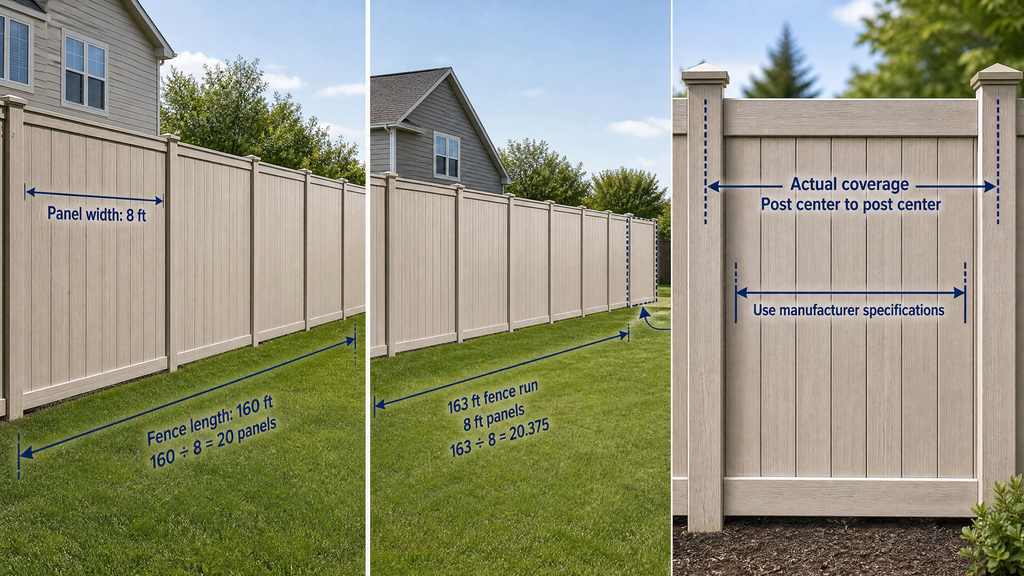
The basic formula is:
Number of panels = Fence length ÷ panel width
Round up to a whole panel.
For example, suppose a straight fence run is 160 feet and each panel covers 8 feet.
160 ÷ 8 = 20 panels
If the manufacturer specifies a panel width that differs from your assumed dimension, use the manufacturer’s actual coverage measurement instead.
This matters because an advertised “8-foot panel” may not always mean the finished installed system covers exactly 8 feet from post center to post center.
Why Panel Layout Matters
Panels don’t always fit perfectly into the measured fence line.
A 163-foot fence run with 8-foot panels gives:
163 ÷ 8 = 20.375
You can’t install 0.375 of a standard panel unless the fencing system allows a panel to be cut or adjusted.
The remaining space may require:
- A cut panel
- A narrower custom section
- Adjusted post spacing
- A different layout
For this reason, the final installation plan should be based on the manufacturer’s installation instructions rather than the calculator alone.
How to Calculate Fence Pickets
Picket fences require a different calculation because both picket width and spacing affect coverage.
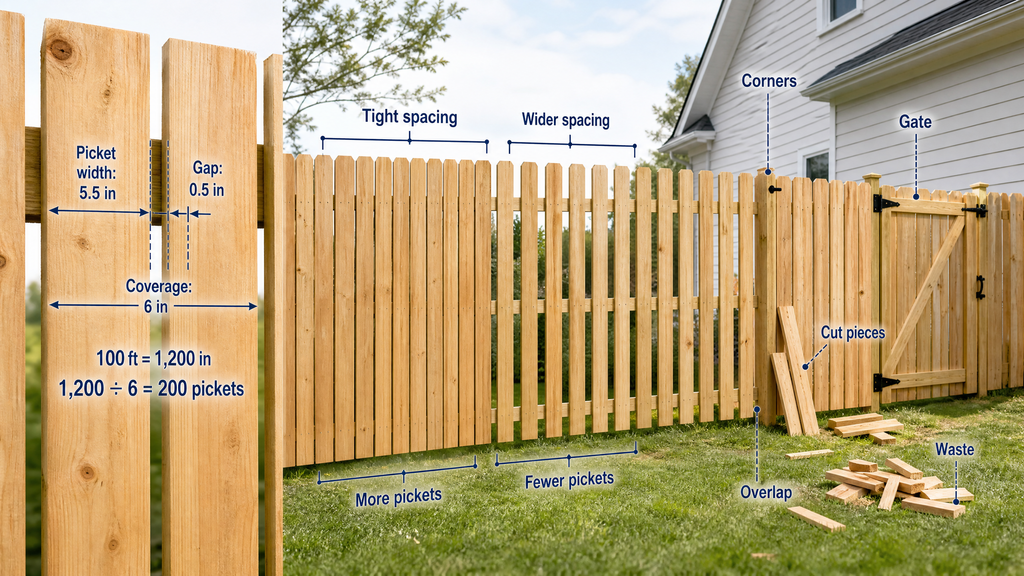
A basic formula is:
Pickets needed = Fence length ÷ coverage per picket
Coverage per picket includes the picket’s actual width plus the desired gap.
For example, suppose:
- Fence length = 100 feet
- Picket width = 5.5 inches
- Gap = 0.5 inch
Combined coverage:
5.5 + 0.5 = 6 inches
Convert the fence length to inches:
100 × 12 = 1,200 inches
Then:
1,200 ÷ 6 = 200 pickets
You would then consider waste and the actual layout.
Picket Spacing
A small change in picket spacing can noticeably change the number of boards required.
A tight privacy-style layout uses more material than a widely spaced decorative fence.
Picket calculations should account for:
- Actual board width
- Gap size
- Fence length
- Fence height
- Cut pieces
- Corners
- Gates
- Waste
If the boards are installed with a specific overlap, calculate coverage based on the manufacturer’s recommended installation method rather than treating the full board width as usable coverage.
Related: Drywall Nail Pops: Causes, Warning Signs & How to Fix Them (2026)
How Much Concrete Do Fence Posts Need?
Concrete requirements depend on the size and depth of each post hole, so there is no single concrete quantity that works for every fence.
A basic way to estimate concrete is to calculate the approximate volume of each hole and multiply it by the number of holes.
For a cylindrical hole:
Volume = π × radius² × depth
Then multiply the result by the number of post holes.
However, actual post-hole dimensions depend on factors such as:
- Fence height
- Post size
- Soil conditions
- Local building requirements
- Frost depth
- Wind exposure
- Manufacturer recommendations
- Local installation practices
Some installations also use gravel or other drainage-related materials at the bottom of the hole.
For a real project, follow local requirements and the fencing manufacturer’s specifications instead of relying solely on a generic concrete calculation.
A concrete calculator can be useful for estimating the volume, but the fence post hole dimensions must be correct first.
How Fence Material Changes the Estimate
The fence material changes much more than the appearance of your yard; it changes what the calculator needs to count.
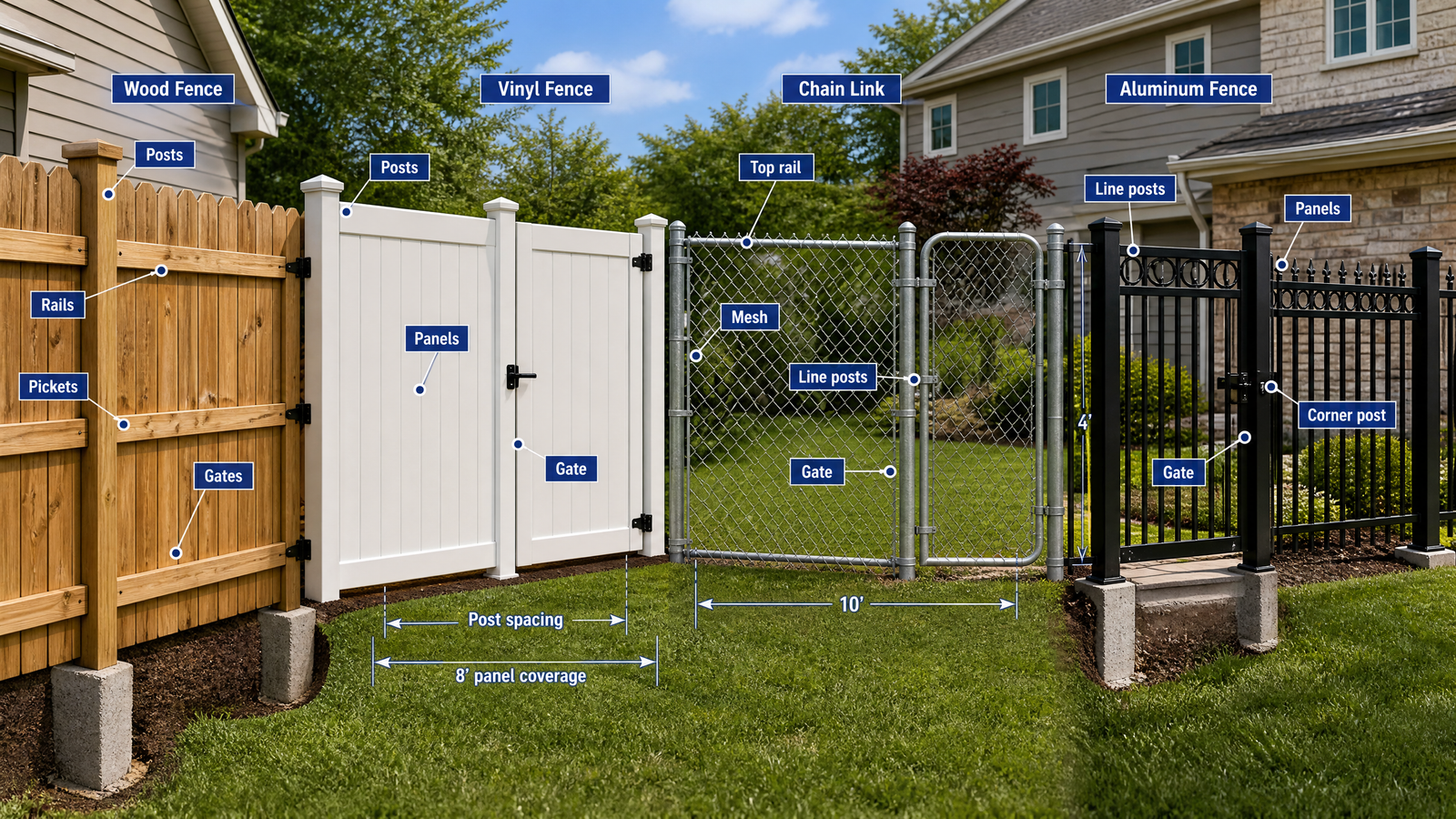
Wood Fence
Wood fencing may use:
- Posts
- Rails
- Pickets or boards
- Fasteners
- Concrete
- Gates
- Post caps
Common residential choices include cedar and pressure-treated wood.
Wood fences are flexible from a design standpoint because individual boards can often be cut and adjusted around corners and irregular layouts. That can make them easier to adapt to unusual fence lines, although waste should still be included.
Maintenance also affects the long-term budget. Depending on the wood and finish, homeowners may eventually need cleaning, staining, sealing, or replacement of damaged boards.
Vinyl Fence
Vinyl fencing commonly uses prefabricated components such as:
- Posts
- Panels
- Rails
- Pickets
- Post caps
- Gates
- Hardware
The manufacturer’s system is particularly important with vinyl because component dimensions and connection methods can vary.
A calculator should use the actual panel coverage and post spacing specified for the product rather than assuming that every vinyl fence uses the same dimensions.
Chain Link Fence
Chain link fencing typically involves:
- Terminal or end posts
- Line posts
- Corner posts
- Top rail
- Chain-link fabric
- Tension wire or related components
- Fittings
- Gates
Chain link calculations can therefore look quite different from wood or vinyl panel calculations.
The height of the fence, mesh size, gauge, framework dimensions, and gate configuration can all affect the material estimate.
Aluminum Fence
Aluminum fencing often comes as prefabricated sections connected between posts.
The estimate may include:
- Line posts
- End posts
- Corner posts
- Panels
- Gates
- Hardware
- Concrete
Decorative aluminum fencing can have additional layout considerations because panel widths and ornamental designs vary by manufacturer.
Related: Wall Cracks: 10 Types, What Causes Them & When to Worry (2026)
How to Estimate Fence Installation Cost
Fence installation cost is usually driven by the total linear footage, material, height, site conditions, and complexity of the job.
A basic project-cost model is:
Total cost = Materials + Labor + Additional project costs
Additional costs can include:
- Old fence removal
- Gate installation
- Permit fees
- Difficult access
- Steep slopes
- Rock or difficult soil
- Landscaping removal
- Custom gates
- Decorative features
- Post upgrades
A calculator can provide a planning estimate, but it cannot know every condition on your property.
What Increases Labor Cost?
A straight fence across level, accessible ground is generally easier to install than a fence with numerous corners, gates, elevation changes, or difficult access.
Labor may increase when the project involves:
- Heavy or rocky soil
- Concrete or existing structures
- Steep slopes
- Dense vegetation
- Long material-carry distances
- Multiple gates
- Many corners
- Custom sections
- Removal of an existing fence
Local labor rates also vary significantly across the United States.
Fence Cost by Material
Material choice can have a major effect on both the initial budget and long-term maintenance.
| Fence Material | Typical Characteristics | Maintenance | Relative Cost |
|---|---|---|---|
| Pressure-treated wood | Practical and widely available | Moderate | Low to moderate |
| Cedar | Natural appearance and rot resistance | Moderate | Moderate |
| Vinyl/PVC | Low-maintenance and consistent appearance | Low | Moderate to high |
| Chain link | Functional and durable | Low | Low to moderate |
| Aluminum | Decorative and corrosion-resistant | Low | Moderate to high |
These are relative comparisons rather than universal installed prices. Actual costs vary by region, product quality, fence height, labor, terrain, gates, and project complexity.
For budgeting, it’s better to obtain local material prices and contractor estimates than to assume a national price per linear foot applies to your property.
Example Fence Calculation
A complete example shows why fence calculations need several inputs rather than one simple perimeter measurement.
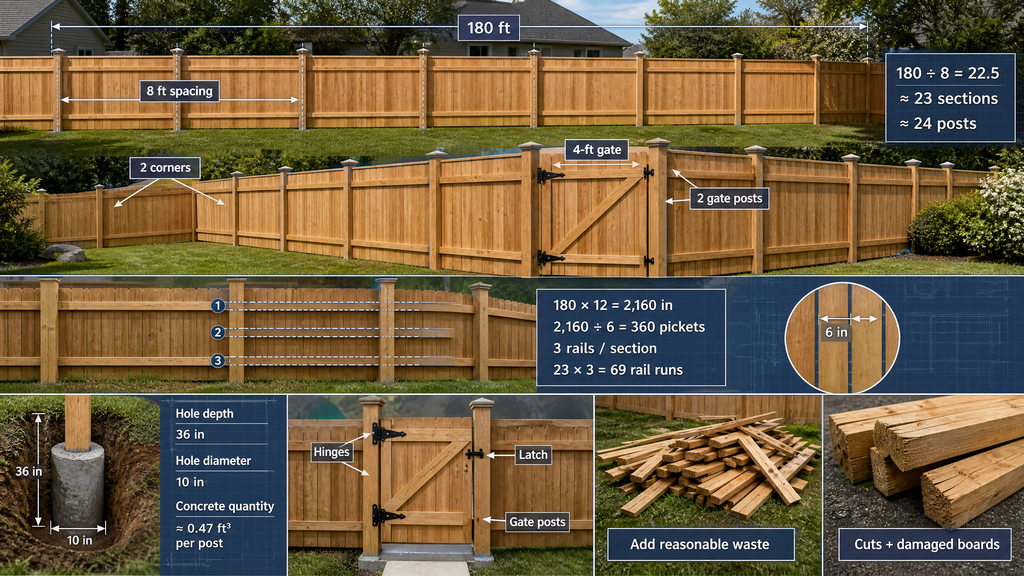
Suppose a homeowner wants:
- 180 linear feet of fencing
- 6-foot height
- Wood privacy fence
- Posts approximately 8 feet apart
- One 4-foot walk gate
- Two corners
- Level terrain
Step 1: Estimate Fence Sections
Start with:
180 ÷ 8 = 22.5
Round up to approximately 23 sections.
Step 2: Consider Posts
A basic straight-run calculation might suggest approximately 24 posts for 23 sections, depending on the arrangement.
However, the actual layout must account for the two corners and the gate opening.
The gate needs two dedicated structural posts, while corner locations may require posts that serve adjoining runs.
Therefore, the final post count should be based on the actual layout rather than simply accepting the division result.
Step 3: Estimate Pickets
Suppose the chosen pickets provide approximately 6 inches of installed coverage each.
Convert:
180 feet × 12 = 2,160 inches
Then:
2,160 ÷ 6 = 360 pickets
A reasonable waste allowance may then be added depending on the design, cuts, damaged boards, and layout.
Step 4: Estimate Rails
If each fence section uses three horizontal rails, then:
23 sections × 3 = 69 rail runs
Again, actual rail lengths and the way they terminate at posts can change the final lumber takeoff.
Step 5: Estimate Concrete
The number of post holes is determined first. Concrete is then calculated using the actual hole dimensions and required depth.
This is where a generic “one bag per post” rule can become misleading. Bag size, hole diameter, hole depth, post dimensions, and installation method all matter.
Step 6: Add the Gate
The gate isn’t just a missing section of fence.
Budget for:
- Gate frame or gate panel
- Hinges
- Latch
- Gate posts
- Concrete
- Additional hardware
Step 7: Add Waste
Finally, account for reasonable material waste.
The exact allowance depends on the fence design and material. A simple straight fence with standard panels may have less waste than an irregular layout requiring many cuts.
Related: German Schmear Brick: How to Get the Look, Cost, Pros & Cons (2026)
Common Fence Calculation Mistakes
Most inaccurate fence estimates aren’t caused by difficult math; they’re caused by missing information.
Measuring the Property Instead of the Fence Line
A property may be rectangular, but the proposed fence may not follow the entire property boundary.
Measure the actual fence layout.
Ignoring Corners
A calculator based only on total footage can underestimate the number of posts and fittings when the fence changes direction.
Forgetting Gate Posts
Gates need structural support and hardware. Treating a gate as simply a gap in the fence can produce an incomplete estimate.
Assuming Every Panel Has the Same Coverage
Manufacturers use different dimensions and connection systems.
Always check the actual product specifications.
Using the Wrong Picket Coverage
A 6-inch board does not necessarily provide 6 inches of installed coverage if there is an overlap, gap, or specific installation pattern.
Ignoring Sloped Ground
A sloped yard can change both the visual layout and the amount of material required.
Depending on the fence design, the installer may step panels, rack sections, shorten individual boards, or make additional cuts.
Forgetting Waste
A material estimate with no allowance for cuts or damaged pieces can leave you short at the end of the project.
Using Yard Area Instead of Linear Feet
A large yard doesn’t necessarily require a long fence, while a narrow property with a large perimeter can require substantial fencing.
Assuming a Calculator Is a Contractor Quote
A calculator estimates quantities and costs from the information entered. A contractor’s quote may include site-specific labor, excavation, removal, delivery, overhead, permits, equipment, and other costs.
DIY Fence Estimate vs. Professional Quote
A DIY material estimate is an excellent way to understand your project before requesting quotes.
It lets you compare materials and identify the major cost drivers.
For example, you can estimate how the project changes if you switch from:
- Wood to vinyl
- A 4-foot fence to a 6-foot fence
- Standard fencing to a privacy design
- One gate to two gates
A professional quote adds another layer of information because the installer can inspect:
- Soil
- Grade
- Property access
- Existing fencing
- Trees and roots
- Utility conflicts
- Drainage
- Actual post locations
- Gate requirements
For a major installation, use your calculator estimate as a planning tool and compare it with at least a few local quotes when practical.
Before You Order Fence Materials
Do one final site check before buying everything at once.
- The actual fence-line measurements
- Property boundaries
- Local fence height requirements
- Permit requirements
- HOA restrictions, if applicable
- Utility locations before digging
- Manufacturer panel dimensions
- Recommended post spacing
- Required post-hole depth
- Gate dimensions and hardware
- Expected waste
- Delivery and material access
Calculator Estimate vs. Actual Material Takeoff
The best way to think about a fence calculator is as the first step in planning, not the final authority.
A calculator is excellent for answering questions such as:
- Approximately how many posts will I need?
- How many panels might cover this fence?
- How many pickets should I budget for?
- How much material could this project require?
- How does changing the fence height affect the estimate?
- How might a second gate change the budget?
The final takeoff should be checked against the actual product specifications and site layout.
Calculator estimates are useful for planning, but final material quantities should be confirmed against the manufacturer’s specifications and your actual site conditions.
Local building requirements should also take priority over a generic calculation.
Related: Vaulted vs Cathedral Ceiling: What’s the Difference? Pros, Cons & Costs (2026)
Fence Calculation Checklist
Before considering your estimate complete, make sure you have:
A few extra minutes spent checking these details can prevent a surprisingly expensive trip back to the home-improvement store.
FAQs
How do I calculate how much fencing I need?
Measure every section of the proposed fence line in linear feet and add the measurements together. Then account for gates, corners, panel dimensions, picket coverage, and reasonable material waste. The actual quantity depends on the fence system you choose.
How many fence posts do I need?
Start by dividing the total fence length by your planned post spacing and round up to determine the approximate number of sections. Then account for end posts, corner posts, and gate posts. The final count depends on the layout and manufacturer’s installation requirements.
How far apart should fence posts be?
Post spacing varies by fence type, height, panel dimensions, soil, wind exposure, and manufacturer specifications. Many residential fences use spacing in the general range of 6 to 8 feet, but you should use the spacing recommended for your specific fence system rather than assuming one distance applies to every project.
How do I calculate fence panels?
Divide the total fence length by the installed coverage width of the panel and round up. For example, 160 linear feet divided by 8 feet of actual panel coverage equals 20 panels. Check the manufacturer’s dimensions because nominal panel width and actual installed coverage can differ.
How do I calculate fence pickets?
Divide the total fence length, converted to inches, by the combined coverage of one picket and its planned spacing. For example, a 5.5-inch picket with a 0.5-inch gap provides approximately 6 inches of coverage. Cuts, corners, gates, and waste can increase the final quantity.
How much concrete do I need for fence posts?
Concrete depends on the number and dimensions of the post holes. Calculate the approximate volume of one hole, multiply it by the number of holes, and then convert that volume to the product size you’re purchasing. Required hole depth and diameter should follow local requirements and the fencing manufacturer’s recommendations.
Does a gate change the fence calculation?
Yes. A gate creates an opening but also requires structural gate posts, hinges, latches, and other hardware. Larger or heavier gates may require stronger posts and additional support, so simply subtracting the gate width from the fence length won’t produce a complete material estimate.
Does fence height affect material requirements?
Yes. A taller fence generally requires taller posts and more fencing material. It can also affect post size, post-hole requirements, wind loading, labor, and overall cost. Local regulations may also limit fence height in certain locations.
How much does it cost to install a fence?
There isn’t one reliable national price because costs vary according to material, fence height, linear footage, labor rates, terrain, gates, removal, access, soil conditions, permits, and local market prices. A calculator can provide a planning estimate, but a local contractor quote is better for a site-specific installation cost.
Can I calculate fence materials myself?
Yes. A homeowner can make a useful preliminary estimate by measuring the fence line, identifying corners and gates, choosing the material, checking panel or picket dimensions, determining post spacing, and estimating concrete and hardware. Before purchasing, compare the calculation with the manufacturer’s specifications and the actual site layout.