
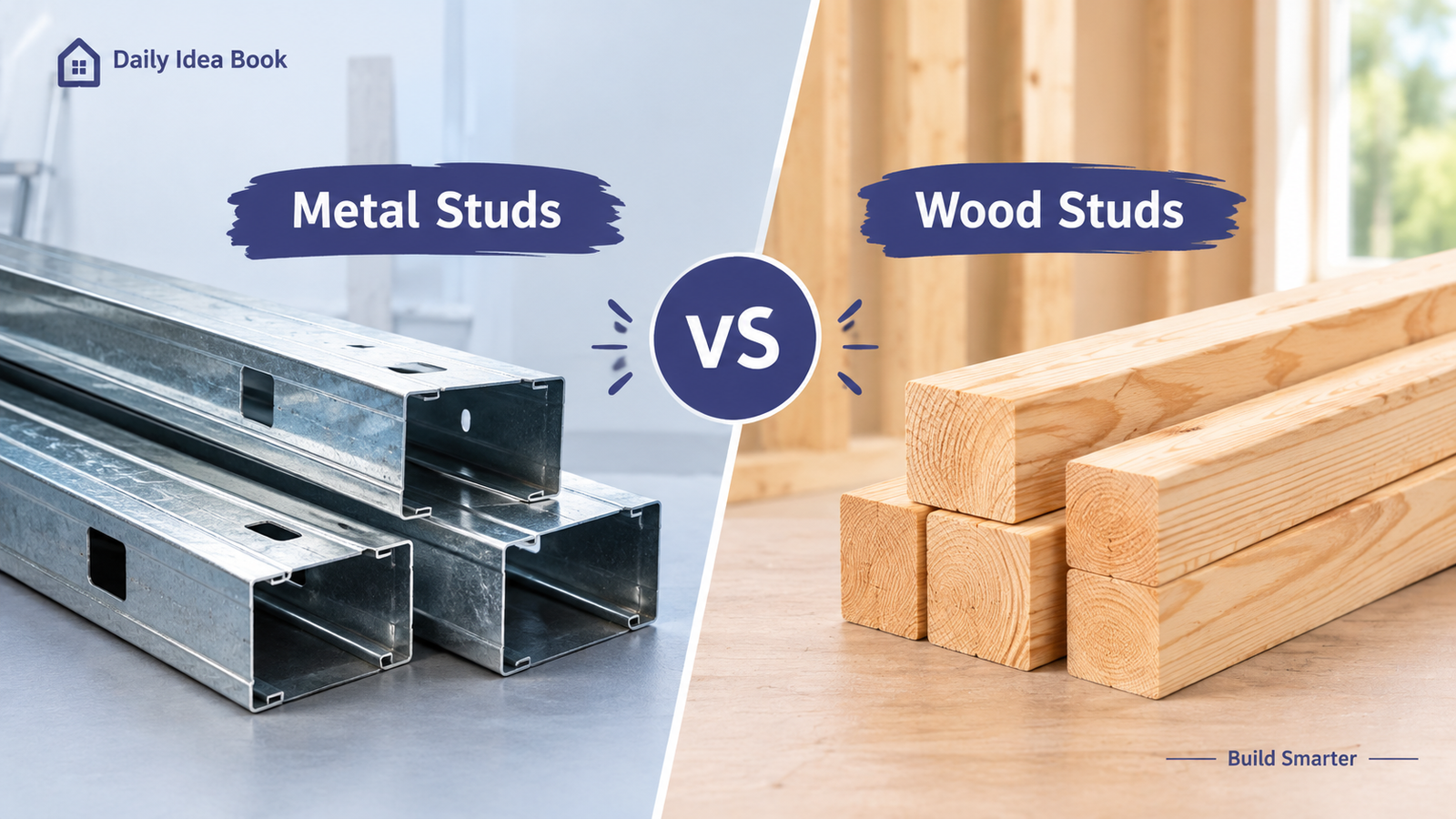
Choosing between metal studs and wood studs can affect the cost, installation, durability, and long-term performance of your wall. Both materials are widely used for framing, but they work best in different situations.
Wood studs have been the traditional choice for residential construction because they are easy to cut, fasten, and work with using common tools. Metal studs, usually made from galvanized or cold-formed steel, offer advantages such as consistent dimensions, resistance to termites and rot, and lighter handling.
The right choice depends on more than simply asking which material is stronger. Your wall type, load requirements, moisture conditions, budget, tools, and plans for hanging cabinets or other heavy items all matter.
If you are planning a larger home improvement project, you may also find our guides on kitchen remodel ideas, bathroom remodel ideas, and small entryway ideas helpful when planning the finished space.
Metal Studs vs Wood Studs: What’s the Difference?
The biggest difference is the material and the way each material handles loads, moisture, fastening, and installation.
Wood studs are generally made from dimensional lumber, commonly used in residential wall framing. A typical wood stud can be cut to size quickly and accepts nails and screws easily.
Metal studs are commonly made from galvanized steel and are formed into C-shaped sections that fit into metal tracks. Many light-gauge metal studs are intended for interior, non-load-bearing partitions, while heavier structural steel framing systems are designed for structural applications.
This distinction is important because not every metal stud is designed to replace a structural wood stud. You should never assume that a lightweight metal partition stud can be used for a load-bearing wall simply because it looks similar to a wood stud.
Stud spacing also matters. Wall framing is commonly laid out at 16 or 24 inches on center, but the correct spacing depends on the framing system, wall design, drywall or sheathing requirements, and applicable building code.
Metal Studs vs Wood Studs at a Glance
A quick comparison makes the main differences easier to understand.
| Feature | Metal Studs | Wood Studs |
|---|---|---|
| Material | Galvanized/cold-formed steel | Dimensional lumber |
| Weight | Generally lightweight | Heavier |
| Cutting | Requires metal snips or suitable cutting tools | Easy with common saws |
| Fastening | Usually screws and specialized fasteners | Nails and screws |
| Moisture resistance | Good, depending on coating and conditions | More vulnerable to moisture |
| Termite resistance | Excellent | Requires pest protection |
| Rot resistance | Does not rot | Can rot when exposed to persistent moisture |
| Straightness | Very consistent | Can bow, twist, or warp |
| Fire performance | Steel itself is non-combustible | Wood is combustible |
| Heavy wall attachments | May require backing or suitable anchors | Easy to reinforce and fasten |
| DIY friendliness | Moderate | Generally easier |
| Common residential use | Interior partitions and selected framing systems | Very common in residential framing |
| Best advantage | Consistency and resistance to rot/pests | Easy installation and strong fastening |
The table shows why neither material is automatically better for every project. Wood is often the simpler choice for residential DIY work, while metal can be attractive when straightness, moisture resistance, pest resistance, or lighter handling is important.
Metal Studs
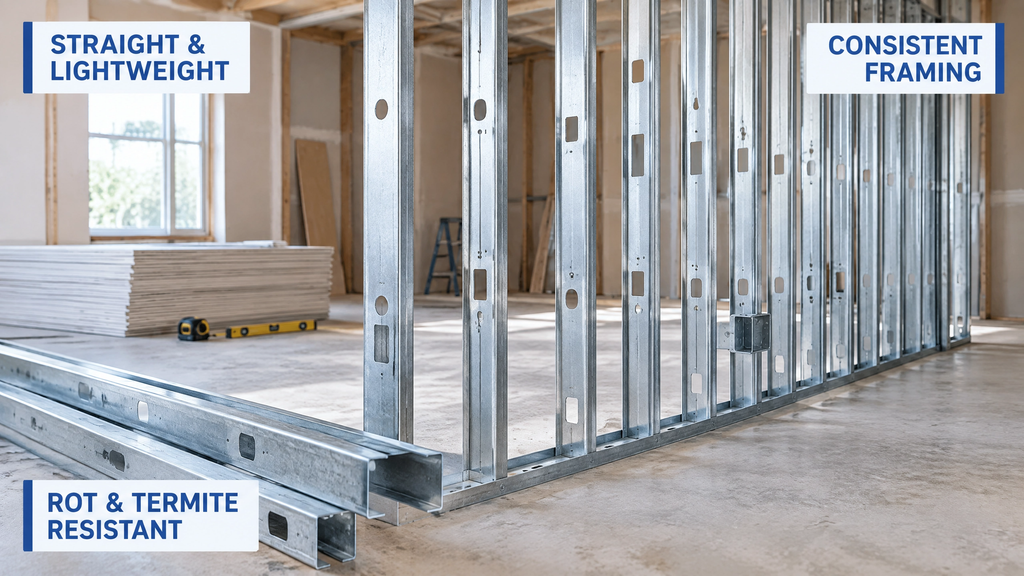
Metal studs are a practical framing option when you want straight, lightweight members that are not affected by rot or termites.
Most residential metal studs used for interior partitions are made from galvanized steel. They are often available with pre-punched openings that can make routing electrical cables and other services easier.
Metal studs are particularly common in commercial construction, but they can also be useful in residential remodeling and interior partition projects. Their suitability depends heavily on the type and gauge of the stud.
Pros of Metal Studs
The biggest advantage of metal studs is their consistent shape and resistance to several common problems that affect wood.
1. They Stay Straight
Metal studs are manufactured to consistent dimensions, so you do not have to sort through pieces looking for boards that are straight.
Wood can develop bends, crowns, twists, or other imperfections. That does not mean good wood framing is unreliable, but it does mean the installer may need to inspect and position each piece carefully.
2. They Resist Rot and Termites
Metal does not rot or provide food for termites.
That makes steel framing attractive where pest problems are a concern. However, metal framing does not mean the entire wall is automatically protected from moisture or mold. Drywall, insulation, wood components, and other materials can still be damaged by water.
A moisture problem should always be corrected at its source rather than relying on metal studs to solve it.
This is particularly important in basements. If you are dealing with moisture below your house, first address the underlying problem. Our guide on water in a crawl space explains why unwanted water should be dealt with before finishing or remodeling a space.
3. They Are Lightweight
Metal studs are generally easier to carry and move around than bundles of dimensional lumber.
This can be helpful when materials need to be carried through a finished home, moved upstairs, or transported through tight spaces.
4. They Are Consistent
Uniform dimensions can make layout and framing more predictable.
Metal studs are manufactured rather than naturally grown, so you generally get less variation from one piece to another.
5. They Resist Fire Better Than Wood as a Material
Steel itself is non-combustible, while wood is combustible.
However, the fire performance of a wall should never be judged by the stud material alone. Drywall type, layers, insulation, fasteners, joints, penetrations, and the complete tested or approved wall assembly can all affect the fire rating.
For a code-required fire-rated wall, follow the exact approved assembly rather than creating your own combination of materials.
Cons of Metal Studs
Metal framing also has limitations, especially when you are used to traditional wood construction.
1. Heavy Attachments Need Planning
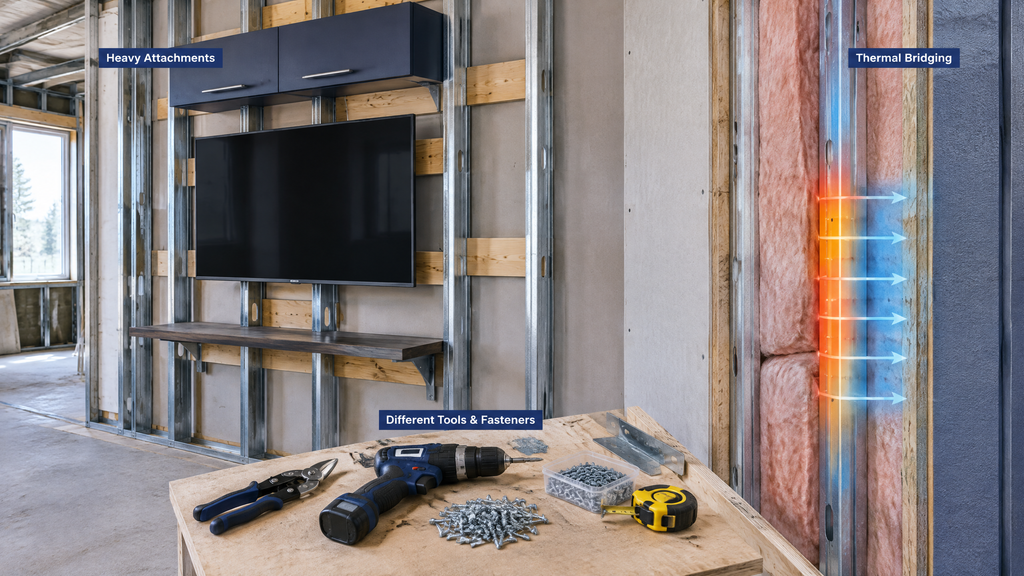
The biggest practical drawback is that lightweight metal studs are not automatically a strong fastening point for every heavy item.
If you plan to install cabinets, large shelves, grab bars, heavy mirrors, or a wall-mounted TV, think about reinforcement before the drywall goes up.
Depending on the wall design, you may use suitable backing, blocking, heavier-gauge framing, or an attachment system specifically designed for the application.
Do not assume that every metal stud has the same capacity. Stud gauge, profile, spacing, connections, and the wall assembly all affect performance.
2. They Require Different Tools and Fasteners
Metal framing is easy to work with once you have the right tools, but it is not exactly the same as working with wood.
Metal snips, appropriate screws, a drill or screw gun, and other tools may be needed depending on the project.
Wood framing is usually more familiar to DIY homeowners because common saws, drills, screws, and nails can handle much of the work.
3. Thermal Bridging Can Matter
Steel transfers heat much more readily than wood, so insulation design matters.
A metal stud can create a path for heat to move through the wall, particularly when the framing interrupts insulation. The actual effect depends on the complete wall assembly and insulation strategy.
For exterior walls, follow the insulation design and local energy requirements rather than selecting studs based only on the framing material.
Wood Studs
Wood remains a popular residential framing material because it is easy to cut, fasten, reinforce, and modify.
For many homeowners, wood is also easier to understand and work with. A standard dimensional lumber stud can be cut with common tools, and screws or nails can be installed without specialized metal-framing fasteners.
Pros of Wood Studs
Wood’s biggest strength is its simplicity and versatility during construction.
1. Easy to Cut and Install
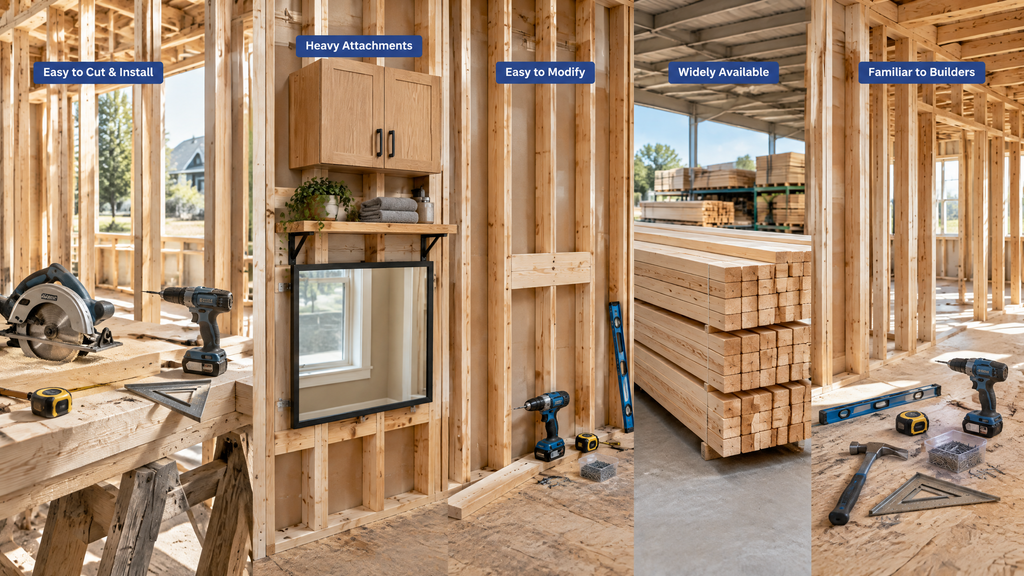
Wood can be cut quickly with common saws and adjusted easily during framing.
This is one reason it remains popular with DIY homeowners and residential contractors.
2. Easy to Attach Heavy Items
Wood provides a convenient fastening surface for many wall-mounted items.
Shelves, cabinets, doors, trim, blocking, and other components can be fastened directly to properly sized wood framing.
That does not mean every wood stud can safely support any load. Heavy items still need suitable framing, fasteners, and load paths.
3. Easy to Modify
Wood is forgiving when you need to make small changes during a project.
You can cut, drill, notch, reinforce, or add blocking when appropriate and permitted by the structural design and building code.
4. Widely Available
Wood studs are commonly stocked by home improvement stores and lumber suppliers.
This makes replacement material easy to find in many areas, which can be especially useful during remodeling.
5. Familiar to Most Residential Contractors
The long history of wood framing means many residential builders and DIYers already have the tools and experience needed to work with it.
That familiarity can reduce the learning curve and may reduce labor costs depending on the project.
Cons of Wood Studs
Wood’s main weaknesses are related to moisture, pests, fire, and natural movement.
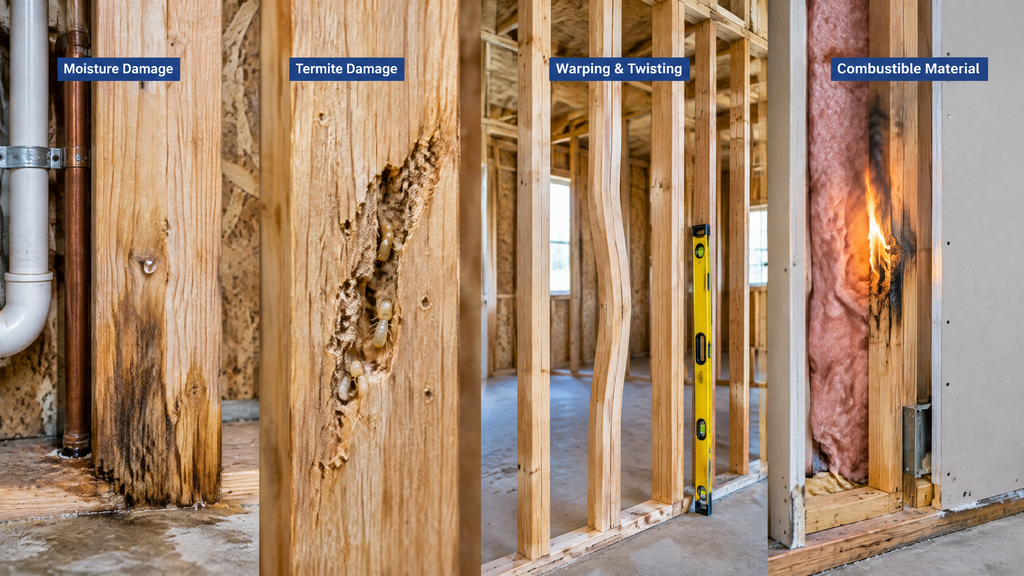
1. Moisture Can Cause Problems
Persistent moisture can cause wood to swell, decay, or eventually rot.
Poor drainage, plumbing leaks, condensation, or water intrusion should be corrected before framing is installed or enclosed.
If you are already seeing structural or surface problems, our guides on wall cracks and cracks in ceiling can help you understand why identifying the cause matters before covering a wall or ceiling.
2. Termites Can Damage Wood
Wood can be vulnerable to termites and other wood-destroying insects.
The level of risk depends on the location, construction details, moisture conditions, and local pest activity. Proper building practices and pest control measures are more important than assuming that every wood-framed wall will develop an insect problem.
3. Wood Can Warp or Twist
Lumber is a natural material, so individual boards can vary in straightness and shape.
Proper material selection and good framing practices help reduce these problems, but some movement is still possible as wood responds to moisture changes.
4. Wood Is Combustible
Wood can burn, so fire performance must be considered as part of the complete wall design.
For walls that require a specific fire rating, use the appropriate tested or approved assembly and follow local code requirements.
Metal Studs vs Wood Studs: Key Differences
The best way to choose between them is to compare the factors that actually matter for your project.
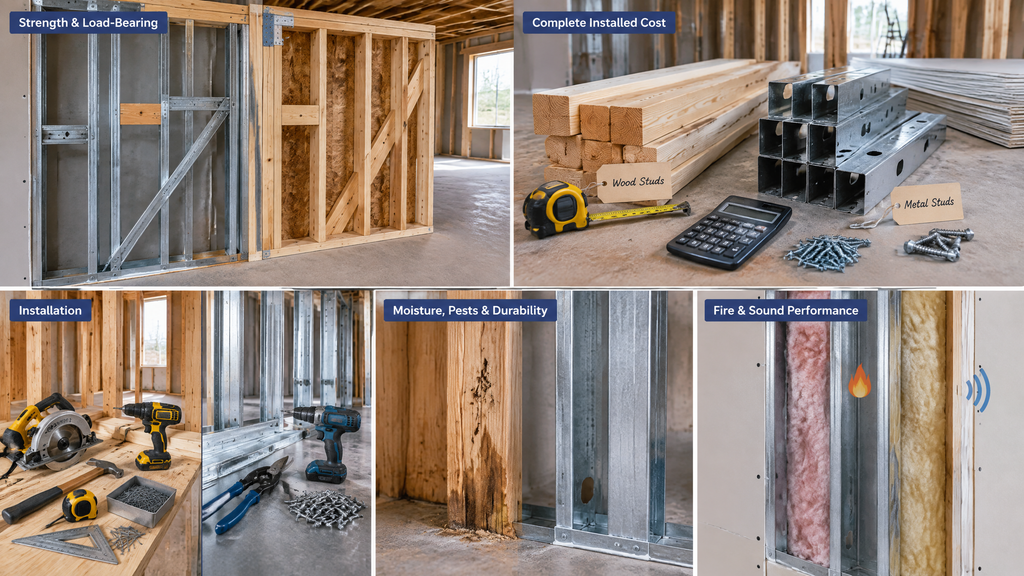
Strength and Load-Bearing
Neither “metal” nor “wood” tells you enough by itself to determine structural strength.
A lightweight metal partition stud is very different from a heavier structural cold-formed steel member. Similarly, wood framing strength depends on species, grade, dimensions, spacing, span, connections, and how the wall is designed.
For a load-bearing wall, structural modification, or major renovation, use the framing specifications provided by the project designer or engineer and follow your local building code.
This is one area where online comparisons can become misleading. Do not choose a framing material simply because someone says metal is stronger or wood is stronger.
Cost
The cheaper material depends on local prices, labor, tools, and the type of framing you are building.
Wood has historically been a cost-effective choice for many residential projects, but lumber prices can change significantly. Metal stud prices also vary by gauge, size, manufacturer, and location.
Labor can change the final cost as well. A material that costs less per piece may not produce the lowest installed cost if it requires additional labor, specialized fasteners, or extra reinforcement.
For that reason, compare the complete installed cost, not just the price of individual studs.
Installation
Wood usually has the easier learning curve for a typical DIY homeowner.
A basic wood-framing project can often be completed with familiar tools. Metal framing can also be fast once you know the process, but cutting and fastening methods are different.
Metal framing can be particularly convenient when straight, lightweight pieces are important. Wood may be easier when you expect frequent modifications, blocking, or heavy fastening.
Moisture, Pests and Durability
Metal has a clear advantage against rot and termites, but it is not completely maintenance-free.
Galvanized steel resists corrosion, but prolonged exposure to moisture or unsuitable conditions can still cause corrosion. Wood, on the other hand, can perform very well when kept dry and properly protected.
The important lesson is simple: good moisture control matters regardless of the framing material.
Fire and Sound Performance
The complete wall assembly matters more than the stud material alone.
Steel itself is non-combustible, but a wall’s fire rating depends on the tested assembly. Sound control also depends on factors such as drywall layers, insulation, resilient channels, air gaps, sealing, and construction quality.
If sound control is your goal, do not expect simply changing from wood to metal studs to solve the problem.
For a related home project, you can also read our comparison of LVP vs laminate flooring when planning a complete room renovation.
When Should You Choose Metal Studs?
Metal studs make the most sense when straightness, lightweight handling, and resistance to rot or termites are important priorities.
They can be a good option for certain interior partitions, commercial-style construction, and projects where you want consistent framing members.
Metal can also be attractive when you are working in a space where carrying long, heavy pieces of lumber is difficult.
However, choose the correct type and gauge of metal framing for the application. Lightweight nonstructural studs should not be treated as a universal replacement for structural framing.
If you plan to mount heavy cabinets, shelves, or televisions, decide where those loads will go before closing the wall.
When Should You Choose Wood Studs?
Wood is often the simplest choice for conventional residential framing and DIY projects.
Choose wood when you want easy cutting, straightforward fastening, broad material availability, and simple options for adding blocking or attaching wall-mounted items.
Wood is particularly practical when your local contractors are experienced with wood framing and the material is readily available at a competitive price.
If you are remodeling an existing home, matching the existing construction method can sometimes make the project simpler as well.
The Reddit discussion shows that real-world experiences with metal and wood studs are much more mixed than a simple “one is better” comparison suggests.
In the Reddit discussion about finishing a basement, commenters mentioned several advantages of metal studs, including their light weight, straightness, ease of locating studs with a magnet, and resistance to problems such as rot. Some experienced users also said they had successfully supported heavy loads from metal framing when the appropriate framing and fasteners were used.
Other commenters raised concerns about below-grade moisture and corrosion, particularly in basements. Several people emphasized that water problems should be solved before framing rather than expecting metal studs to compensate for a wet environment.
Another useful point from the discussion was that metal stud gauge matters. One construction professional noted that lighter-gauge studs should not automatically be treated like heavier structural members and suggested using proper backing when substantial loads need to be attached to the wall.
Our Take on the Discussion
The most useful lesson from the Reddit conversation is that the framing material should be chosen around the actual project, not based on a blanket rule.
The commenters who preferred metal often valued its straightness, light weight, and resistance to rot and pests. Those who preferred wood often focused on its easier installation and ability to provide convenient fastening for shelves, cabinets, and other wall-mounted items.
Those experiences are useful, but Reddit comments should be treated as personal experience rather than engineering or building-code guidance.
For a homeowner, the practical takeaway is simple: if you are building a typical residential wall and want the easiest installation and straightforward fastening, wood is often the more convenient option. If you are building a suitable non-load-bearing partition and value lightweight, straight, pest-resistant framing, metal can be an excellent choice.
Metal Studs vs Wood Studs: Which Is Better?
For most traditional residential framing, wood is often the easiest all-around choice, but metal can be better for specific applications.
There is no universal winner.
Choose wood studs when ease of installation, easy fastening, availability, and traditional residential construction are your main priorities.
Choose metal studs when lightweight framing, dimensional consistency, and resistance to termites and rot are more important.
For load-bearing walls, do not make the decision based on general internet comparisons. Use the structural design, manufacturer’s specifications, and applicable building code.
The best framing material is ultimately the one that fits the wall’s purpose, performs correctly in its environment, and can be installed properly.
Things to Check Before Choosing Studs
A few checks before buying materials can prevent expensive changes later.
If you want an easy-to-install framing material for a typical residential project, wood is usually the straightforward choice. If you need lightweight, straight, pest-resistant framing for an appropriate application, metal studs may be the better fit. For structural walls, always follow the project’s engineering and local code requirements.
Final Thoughts
Metal studs and wood studs can both produce excellent results when they are selected and installed for the right application.
Wood remains a practical choice for many homeowners because it is easy to cut, fasten, reinforce, and modify. Metal offers its own advantages, especially its consistent dimensions, lightweight handling, and resistance to termites and rot.
Instead of asking “Which is better?”, ask “Which material is better for this wall?”
That small change in thinking can lead to a much better decision. Consider the wall’s structural role, moisture exposure, attachment needs, installation method, budget, and local requirements before buying your framing materials.
For more practical home improvement guides, explore Daily Idea Book’s Home & Living section and our Blog section.
Frequently Asked Questions
Are metal studs stronger than wood studs?
There is no simple yes-or-no answer because stud strength depends on the exact material, size, gauge, grade, spacing, connections, and wall design. Lightweight metal partition studs should not be compared directly with structural wood framing.
Are metal studs cheaper than wood studs?
The final cost depends on local material prices, labor, tools, fasteners, and reinforcement. Wood may be cheaper in one market while metal may be competitive in another, so compare the complete installed cost.
Which is better for residential walls?
Wood is often the easier choice for conventional residential framing, especially for DIY projects. Metal can be an excellent alternative for suitable interior partitions and applications where straightness and resistance to rot and termites are priorities.
Can you hang heavy items on metal studs?
Yes, but the attachment method and stud type matter. Heavy cabinets, shelves, TVs, and similar loads may require appropriate anchors, blocking, plywood backing, or heavier-gauge framing.
Do metal studs rust?
Metal studs can corrode when exposed to prolonged moisture or unsuitable conditions. Galvanized coatings provide corrosion resistance, but they do not make steel completely immune to rust.
Which is better for a basement?
Neither material automatically solves a basement moisture problem. Before framing a basement, make sure water intrusion and moisture issues are properly addressed. Then select a framing system that meets the project’s construction and code requirements.
Can metal studs be used for load-bearing walls?
Some metal framing systems are specifically designed for structural applications, while many light-gauge interior studs are not. Always verify the manufacturer’s specifications and structural design before using metal studs for a load-bearing application.